
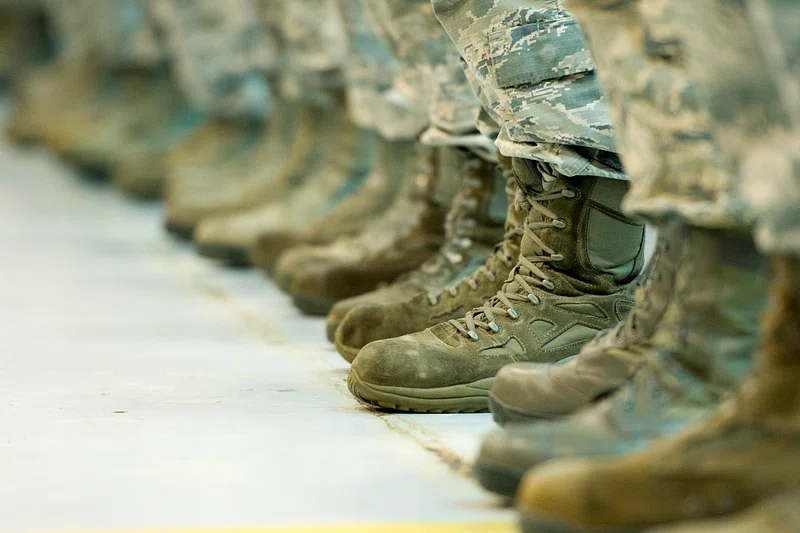
Ask any soldier, and they’ll tell you: your boots can make or break the mission.
In military operations—whether it’s a desert patrol, mountain assault, or urban raid—footwear isn’t just comfort, it’s survival. Tactical boots are built for terrain dominance, ankle support, and all-day endurance, with materials designed to resist heat, water, and wear.
Let’s break down what makes a real military boot—and how to source the right pair for your team.
Why Tactical Boots Matter in the Field
Your boots are the first point of contact between you and the battlefield.
A proper tactical boot must:
- Protect against punctures, heat, and harsh terrain
- Provide ankle support during rapid movement
- Prevent slips, blisters, and foot fatigue
- Withstand mud, rain, sand, and oil
- Be comfortable enough for 12+ hours of wear per day
⚠️ Poor-quality boots lead to injuries, fatigue, slower response—and in combat, seconds matter.
✅ That’s why military boots are more than footwear. They’re critical gear.
Anatomy of a Military-Grade Tactical Boot
Each part of a tactical boot is designed with intention. Here’s what to look for:
| Boot Component | Tactical Function |
|---|---|
| Outsole | Slip resistance, grip on sand, rock, wet surfaces |
| Midsole | Shock absorption, arch support for long marches |
| Insole | Breathable padding, moisture wicking |
| Upper | Ankle protection, abrasion resistance |
| Toe Cap | Impact protection (can be steel or composite) |
| Heel Counter | Stability when stopping, turning, or crouching |
| Lacing System | Quick tighten/loosen under time pressure |
| Drainage ports | Let water escape during amphibious movement |
✅ Tip: Field boots often prioritize drainage + breathability, while desert or jungle boots emphasize sand/mud control.
Key Performance Features to Look For
When sourcing tactical boots, performance is more than just “looks tough.” Look for:
- Slip-Resistant Outsoles: Vibram® or lugged rubber for rough terrain
- Breathable Materials: Nylon mesh, quick-dry linings, antimicrobial insoles
- Oil & Acid Resistance: Especially for logistics or maintenance crews
- Ankle & Heel Stability: High-cut design with molded heel counter
- Heat Resistance: Uppers rated for contact with hot surfaces
- Anti-fatigue Footbed: EVA midsoles or PU cushioning for long wear
- Lightweight Build: Under 1.5kg per pair for speed and agility
⚠️ Beware of boots that "look tactical" but use cheap soles or stiff materials—they’ll cause more damage than protection.
Combat Zones and Boot Requirements
Different environments call for different boot features.
Suggested boot types by deployment:
| Environment | Recommended Boot Features |
|---|---|
| Desert | Lightweight, breathable, sand-resistant, tan suede |
| Jungle | Drainage ports, fast-dry lining, anti-fungal insole |
| Urban | Puncture-resistant outsole, reinforced toe |
| Mountainous | Strong ankle support, grippy outsole, rigid midsole |
| Snow/Cold Weather | Insulated lining, waterproof membrane, traction soles |
✅ Many military boots follow regional camouflage rules, so outsole and upper colors (Coyote Brown, Sage Green, Black) must match uniform regs.
Military Boot Standards and Certifications
When sourcing for government or defense use, compliance matters.
Common standards:
- MIL-SPEC / MIL-STD: U.S. military construction standards
- NFPA 1977: Wildland firefighting boot flame resistance
- ASTM F2413: Impact and compression protection for toe caps
- EN ISO 20347: European occupational footwear standard
✅ Always request testing certificates and confirm heel energy absorption, toe impact, and slip resistance scores.
Sizing, Fit, and Break-In Period
A tactical boot must fit snug but not tight—too loose and you’ll get blisters, too tight and you’ll lose circulation.
Sourcing tips:
- Offer half sizes and wide options (EE or EEE)
- Break-in time should be <10 hours of walking
- Avoid boots that crease heavily at the toe—they’ll wear out fast
- Provide sizing charts per region (EU, US, UK)
- For team orders, allow fit testing sets or size runs
✅ Many modern boots come with removable insoles, allowing workers to insert orthotics or shock-absorbing pads.
Customization and Branding Options
For military contractors, PMC teams, or defense training units, you may want to:
- Add custom pull-tabs or unit tags
- Use specific color schemes or sole tones
- Provide options with or without steel toe
- Package boots with branded laces or inserts
We offer OEM support for tactical footwear with low MOQs + modular options for both function and brand presentation.
Conclusion
Tactical boots are not just rugged—they’re mission-critical equipment that can improve mobility, reduce fatigue, and prevent injury across the toughest terrains.
When sourcing military-grade boots:
- Choose based on operational environment
- Verify certifications and material specs
- Prioritize comfort, drainage, and traction
- Ask your supplier about fit trials and testing data
Need help matching tactical boot models to specific terrain, uniform regulations, or user roles? I’ve worked with clients across combat zones and climate types—we can help you step confidently into any contract.
📩 Contact: [email protected]
🌐 Visit: www.workwearsolutions.net

 Architecting Resilience: Single Sourcing vs. Dual Sourcing Strategies in Global PPE Procurement2026年4月30日Executive Summary In the complex landscape of industrial […]
 Pattern Grading for Global Bodies: The Engineering of Anthropometric Fit in Industrial Workwear2026年4月29日In the highly regulated landscape of industrial Personal […]
 The “Light Box” Inspection: Deconstructing Fabric Defect Diagnostics and the 4-Point Quality System2026年4月28日The structural integrity and visual uniformity of […]
 The Engineering of Waterproof Breathable Workwear: A Forensic Analysis of PU Coatings vs. PTFE Membranes2026年4月24日The selection of waterproof foul-weather gear in industrial […]
 The “Button Pull” Test Protocol: Engineering Fastener Security to Mitigate Industrial Machinery and Choking Hazards2026年4月22日The “Button Pull” Test Protocol: Engineering […]
 Fabric Shrinkage in Industrial Workwear: The Sanforization Secret and the Physics of Dimensional Stability2026年4月18日Executive Summary In the global industrial workwear and […]