
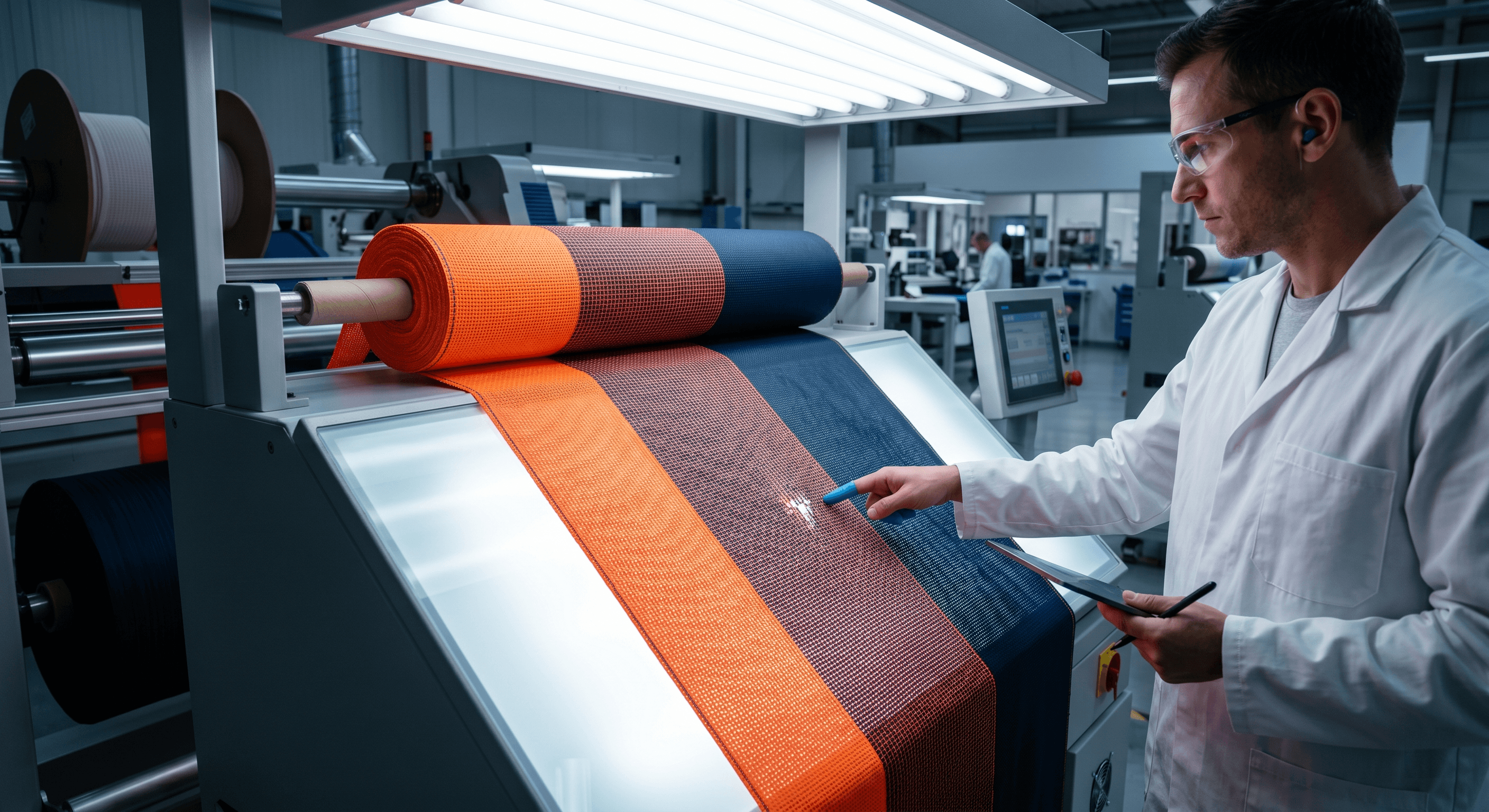
The structural integrity and visual uniformity of industrial workwear and Personal Protective Equipment (PPE) are determined long before the first pattern is cut. In high-stakes manufacturing environments where garments must withstand mechanical abrasion, chemical exposure, and thermal hazards, latent textile defects are not merely cosmetic—they are catastrophic safety liabilities. By implementing rigorous optical transillumination protocols (the "Light Box" inspection) and leveraging the globally recognized ASTM 4-Point System, sophisticated procurement teams intercept weaving anomalies, yarn-level structural compromises, and dye lot variances at the raw material stage. This technical guide forensically analyzes the mechanics of fabric inspection, the mathematics of defect grading, and the supply chain ROI of preventative quality assurance.
Google Snippet: Quick Answer
The "Light Box" inspection is a critical pre-production quality assurance protocol utilizing controlled optical transillumination to detect weaving, dyeing, and structural defects in raw fabric rolls before cutting. Utilizing the ASTM D5430 4-Point System, inspectors assign penalty points based on the size of warp and weft anomalies. Fabrics scoring above 40 points per 100 square yards are categorically rejected, ensuring that PPE is manufactured exclusively from structurally homogeneous textiles, thereby eliminating catastrophic seam failures and safety hazards in the field.
1. The Physics/Problem: Anatomy of Textile Failures
Raw fabric is an engineered grid of interlaced warp (longitudinal) and weft (transverse) yarns. During the complex processes of spinning, weaving, and dyeing, numerous mechanical and chemical variables can induce micro-level anomalies. When these anomalies are subjected to the dynamic stresses of an industrial work environment, they act as initiation points for structural failure.
The Mechanics of Structural Compromise
- Tensile Stress Concentration: A "dropped pick" (missing weft yarn) or "end out" (missing warp yarn) breaks the continuous distribution of tensile force across the fabric matrix. When a worker bends, lifts, or reaches, kinetic energy is concentrated at this weakened juncture, rapidly accelerating tear propagation.
- Tribological Weaknesses: "Slubs" (abnormally thick areas of yarn) or "knots" create localized high points on the fabric topography. These protrusions suffer disproportionate friction against external surfaces, leading to premature localized abrasion and eventual puncture.
- Chemical and Coating Adhesion Failures: Invisible variations in fabric density—detectable only via backlighting—can cause uneven absorption during durable water repellent (DWR) or flame resistant (FR) chemical padding. This results in dangerous "bald spots" where the protective finish is fundamentally absent.
- The "Clown Suit" Phenomenon (Metamerism and Shading): Side-to-side or end-to-end shading occurs when dye exhaustion varies across a fabric roll. If uncut fabric is not mapped for shade bands under standard D65 illumination, a single garment may be sewn using mismatched panels, destroying brand integrity and corporate uniformity.
Attempting to identify these root-level defects post-sewing is scientifically impossible, as seams, linings, and pockets obscure the fabric’s internal topography.
2. Relevant Standards: The Regulatory Framework
A robust QA/QC protocol must be anchored in empirical, internationally recognized standard test methods. The tables below outline the critical regulatory frameworks governing optical textile inspection.
| Standard Designation | Title / Scope | Relevance to Workwear Procurement |
|---|---|---|
| ASTM D5430-13(2017) | Standard Test Methods for Visually Inspecting and Grading Fabrics | The definitive global standard outlining the 4-Point System. Dictates how penalty points are assigned based on longitudinal and transverse defect measurements. |
| ISO 8498:1989 | Woven fabrics — Description of defects — Vocabulary | Ensures standardized terminology between buyers and mills (e.g., differentiating a "smash" from a "float"), crucial for cross-border supply chain communication. |
| AATCC EP9 | Visual Assessment of Color Difference of Textiles | Standardizes the ambient lighting requirements (e.g., D65 daylight simulators at 1000+ lux) for evaluating shade variations during the light box inspection. |
| JIS L 0105 | General Principles of Physical Testing Methods for Textiles | The Japanese Industrial Standard equivalent, highly relevant when sourcing raw textiles from advanced synthetic mills in Asia. |
3. Material/Engineering Solution: The 4-Point System Methodology
The "Light Box" inspection machine is a specialized piece of engineering. Fabric is threaded from a raw roll, passed over an inclined viewing surface (typically angled at 45° to 60° to minimize operator cervical strain), and rewound.
The Illumination Architecture
The inspection requires dual-source illumination:
- Overhead Illumination (Incident Light): Powered by D65 fluorescent or calibrated LED arrays providing a minimum of 1076 lux. This highlights surface defects, color smears, pilling, and shade bands.
- Backlighting (Transillumination): The glass panel beneath the fabric is illuminated from behind. This allows light to penetrate the fabric matrix, instantly exposing pinholes, missing yarns, uneven weaving density, and hidden structural tears.
The ASTM D5430 4-Point Grading Mathematics
The 4-Point System is an objective, mathematical rubric designed to penalize defects based purely on their dimensional severity, removing subjective operator bias.
Point Allocation Matrix (Based on Defect Length):
- 1 Point: Defect is 0 to 3 inches (0 – 76.2 mm).
- 2 Points: Defect is >3 inches up to 6 inches (76.2 – 152.4 mm).
- 3 Points: Defect is >6 inches up to 9 inches (152.4 – 228.6 mm).
- 4 Points: Defect is >9 inches (>228.6 mm).
- Note: A maximum of 4 penalty points can be assessed for any single linear yard of fabric, regardless of the number of defects present.
Special cases: Holes or continuous missing yarns are heavily penalized. A hole 1 inch or less is automatically 2 points; a hole over 1 inch is automatically 4 points.
The Diagnostic Formula:
To normalize the data across different roll lengths and fabric widths, the total points must be calculated per 100 square yards.
Total Points per 100 Sq. Yds = (Total Penalty Points of Roll × 3600) / (Total Yards Inspected × Fabric Cuttable Width in Inches)
The Threshold of Acceptability: In elite industrial workwear manufacturing, the maximum allowable threshold is strictly 40 points per 100 square yards. Rolls scoring 41 or higher are categorically quarantined and returned to the mill.
4. Case Study Comparisons: Blind Cutting vs. Optical QA
The table below quantifies the operational and financial outcomes of relying on final garment inspection versus implementing a strict Light Box fabric inspection protocol.
| Variable | "Budget" Protocol (Blind Cutting) | "Engineered" Protocol (100% Light Box QA) |
|---|---|---|
| Inspection Methodology | Relies on AQL 2.5 final garment visual check. No pre-cut optical scanning. | 100% of rolls undergo Light Box transillumination; ASTM D5430 grading. |
| Material Utilization | Cutters blindly slice through slubs and pinholes, incorporating them into garment panels. | Defective zones are flagged with colored tagging yarn; markers are adjusted to bypass flaws. |
| Garment Reject Rate | 8% – 12% of fully sewn garments fail final QC due to fabric flaws located mid-panel. | < 0.5% garment rejection rate, as fabric defects are eliminated prior to labor investment. |
| Field Failure Risk | High. Micro-tears missed in final QC escalate to seam blowouts under mechanical load. | Near Zero. Fabric matrix integrity is guaranteed before entering the sewing floor. |
| Aesthetic Output | "Clown Suit" effect. Panels cut from different shade zones result in two-tone garments. | Uniformity guaranteed. Shade bands are segregated; rolls grouped by delta-E values. |
5. Common Procurement Mistakes
Procurement officers frequently misallocate QA budgets by ignoring raw material validation.
| The Procurement Mistake | The Supply Chain Impact | The Forensic Prevention Strategy |
|---|---|---|
| Ignoring the "Width" Variable | Calculating fabric yield based on nominal width, ignoring compromised selvedge edges detected by the light box. | Mandate that the 4-Point calculation strictly utilizes the cuttable width (inside the selvedge pins). |
| Relying Only on Factory Self-Reporting | Factories may "fudge" light box data to avoid material shortages and production delays. | Require timestamped video logs of the light box inspection and digital export of the defect mapping software. |
| Accepting High Point Thresholds | Accepting a 50-point threshold for "heavyweight" fabrics under the false assumption that thick fabrics hide defects. | Strictly enforce the 40-point rule. Heavyweight defects (like massive slubs) cause severe needle breakage and weak seams during heavy-duty sewing. |
| Omitting Speed Regulations | Factories run the light box machine at 30+ yards per minute, making it impossible for the human eye to track anomalies. | Contractually limit inspection speed to a maximum of 15 yards per minute to prevent operator visual fatigue. |
6. ROI Analysis: The Mathematics of Waste
Why is investing in front-end Light Box inspection economically superior to relying on final-garment QC? The answer lies in the concept of Value Addition Traps.
Consider a production run of 1,000 inherently flame-resistant (FR) coveralls.
- Fabric Cost: $25 per garment yield.
- Cut, Make, Trim (CMT) Labor & Findings (Zippers, Tape): $20 per garment.
- Total Cost of Goods Sold (COGS): $45 per garment.
Scenario A: Without Light Box Inspection A roll containing severe warp defects is cut and sewn into 50 garments. The defects are only discovered during final packing.
- Financial Loss: 50 garments × $45 = $2,250 wasted. You have paid for labor, zippers, and shipping on compromised raw material.
Scenario B: With Light Box Inspection The roll is scanned at the raw stage. It scores 65 points per 100 sq. yds. The roll is rejected and replaced by the mill at no cost.
- Inspection Labor Cost (20 minutes at $15/hr): $5.00.
- Financial Loss Prevented: $2,250.
The ROI on pre-production optical fabric inspection is exponential. By intercepting the defect at the raw material stage, you avoid investing highly skilled sewing labor and expensive trims into doomed fabric.
7. Buyer Checklist: Auditing a Supplier’s Light Box Protocol
When evaluating an OEM or workwear supplier, use this forensic checklist to audit their raw material QA processes:
- [ ] Equipment Calibration: Does the factory have a documented maintenance log verifying that overhead D65 bulbs are replaced every 1,000 hours to prevent lumen degradation?
- [ ] Machine Architecture: Are the Light Box machines equipped with variable speed controllers and digital yardage counters?
- [ ] Inspection Speed Limits: Is the inspection speed demonstrably capped at ≤ 15 yards (13.7 meters) per minute?
- [ ] Operator Rotation: Are inspection operators rotated every 2 hours to mitigate optical fatigue and "snow blindness" from the backlight?
- [ ] Data Integration: Does the factory utilize software to digitize the 4-Point score, generating a "defect map" that is sent to the CAD/CAM cutting department to optimize marker placement?
- [ ] Shade Band Segregation: Does the inspection protocol include cutting a 6-inch head-end swatch to verify side-to-side and end-to-end shading before cutting begins?
8. Frequently Asked Questions (FAQ)
Q1: Why is the 4-Point System preferred over the 10-Point System for workwear? A: The 10-Point system (primarily used for high-end suiting) is overly complex and penalizes minor visual flaws too heavily. Industrial workwear prioritizes structural integrity. The 4-Point System provides a streamlined, mathematically scalable metric that heavily penalizes large, structurally dangerous defects while allowing minor, non-compromising visual flaws inherent to heavy canvas or twill.
Q2: Will a Light Box detect problems with a fabric’s Flame Resistant (FR) or waterproof capabilities? A: No. Optical transillumination is strictly for structural and visual defect identification (holes, tears, weaving flaws, dye shading). Chemical compliance (e.g., vertical flame tests, hydrostatic head tests) requires destructive laboratory analysis.
Q3: What happens if a fabric roll scores 45 points but we are facing a critical delivery deadline? A: In emergency scenarios, a "cut-around" protocol is initiated. The CAD department adjusts the digital cutting markers to physically avoid the mapped defect zones. This drastically reduces the material yield (increasing fabric consumption by up to 20%) but ensures zero defective garments reach the sewing line.
Q4: Does backlighting matter for heavy fabrics like 300gsm Cotton Drill? A: Absolutely. While less light penetrates 300gsm fabric compared to a 150gsm poplin, high-lumen backlighting will still expose catastrophic matrix failures—such as a continuous missing weft yarn—that are entirely invisible under top-down lighting due to the fabric’s thick surface twill line.
9. Advanced Sourcing Strategies: Digital Fabric Mapping
The future of raw material inspection is moving beyond human optical validation. Elite supply chains are integrating Automated Optical Inspection (AOI) utilizing AI computer vision.
Instead of an operator manually assigning penalty points, high-speed camera arrays scan the fabric as it unrolls, using machine learning algorithms trained on thousands of defect topologies to automatically grade the fabric. Crucially, this system generates a Digital Twin (a digital map) of the fabric roll. This map is fed directly into the automated laser-cutting machine’s ERP system. The AI then dynamically alters the pattern marker in real-time, arranging garment panels around the invisible defect zones with millimeter precision, optimizing fabric yield while mathematically guaranteeing zero defects in the final cut panels.
10. Conclusion
In the B2B industrial workwear sector, quality cannot be inspected into a garment at the end of the production line; it must be engineered from the molecular and yarn levels upward. The "Light Box" inspection and the rigorous application of the ASTM 4-Point System represent the first, and most critical, line of defense against catastrophic garment failure.
Allowing unchecked fabric to enter the cutting room is an abdication of supply chain responsibility. By demanding objective optical transillumination data from your suppliers, you transition your procurement strategy from reactive troubleshooting to proactive engineering—ensuring maximum safety for the end-user and maximum ROI for the enterprise. Quality is not a happy accident; it is the result of relentless, calculated measurement.
📩 Need help sourcing or auditing The "Light Box" Inspection? We specialize in technical apparel engineering and quality assurance. Email: [email protected] 🌐 www.workwearsolutions.net

 Architecting Resilience: Single Sourcing vs. Dual Sourcing Strategies in Global PPE Procurement2026年4月30日Executive Summary In the complex landscape of industrial […]
 Pattern Grading for Global Bodies: The Engineering of Anthropometric Fit in Industrial Workwear2026年4月29日In the highly regulated landscape of industrial Personal […]
 The Engineering of Waterproof Breathable Workwear: A Forensic Analysis of PU Coatings vs. PTFE Membranes2026年4月24日The selection of waterproof foul-weather gear in industrial […]
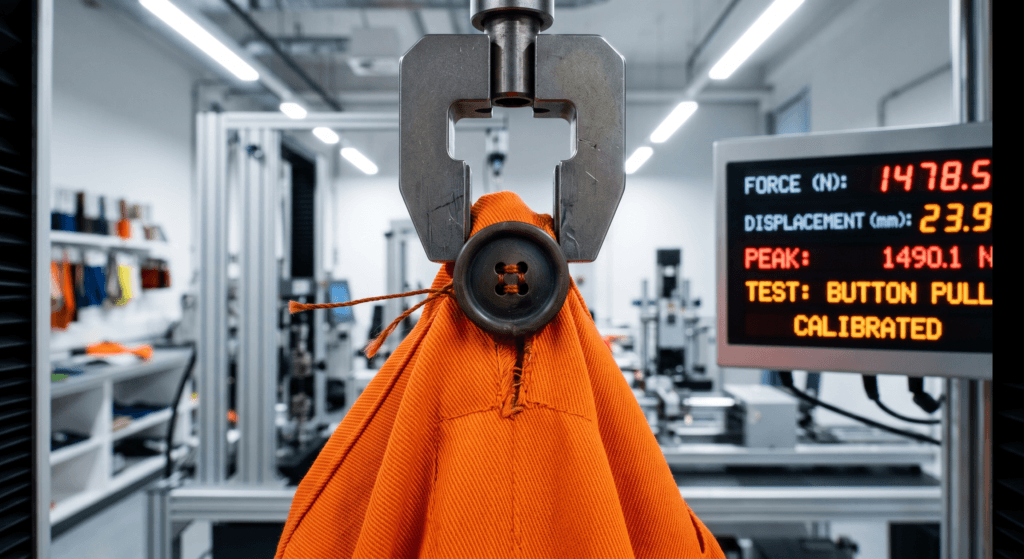 The “Button Pull” Test Protocol: Engineering Fastener Security to Mitigate Industrial Machinery and Choking Hazards2026年4月22日The “Button Pull” Test Protocol: Engineering […]
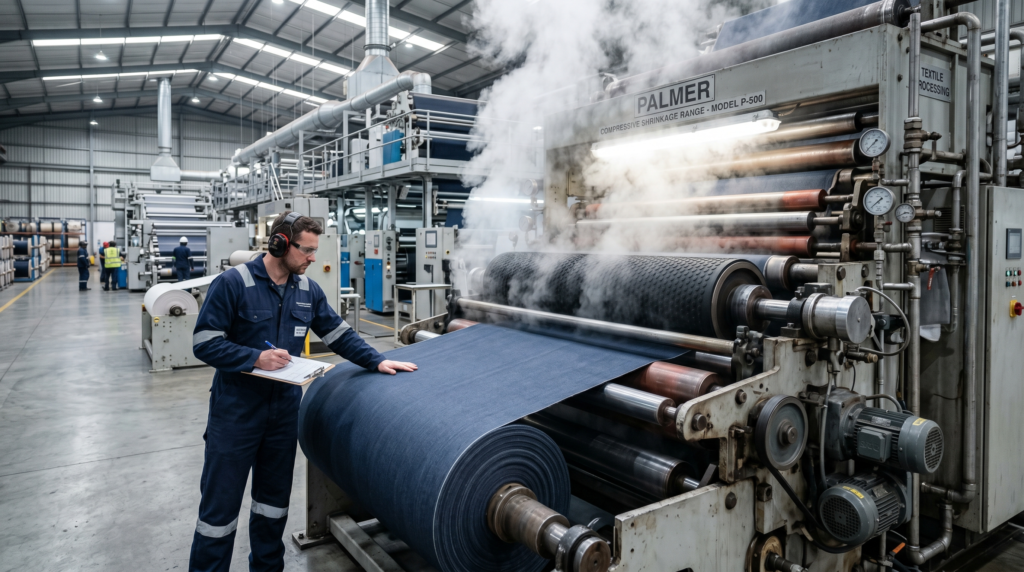 Fabric Shrinkage in Industrial Workwear: The Sanforization Secret and the Physics of Dimensional Stability2026年4月18日Executive Summary In the global industrial workwear and […]
 Color Consistency: The Delta-E Standard and the End of the “Clown Suit” Effect2026年2月4日In the corporate world, a uniform is a brand’s […]