

Executive Summary: From "Ownership" to "Access"
For decades, the standard approach to industrial workwear was simple: Buy it, issue it, and hope it lasts. This "Ownership Model" inevitably leads to the Inventory Bloat Paradox: Companies buy thousands of garments, yet workers constantly complain about shortages.
Why? Because owning stock creates "Phantom Inventory"—uniforms hiding in lockers, lost in home laundry, or sitting dead in a warehouse due to size mismatches. For large Food Plants and Logistics Centers, this inefficiency ties up massive capital and creates hygiene risks.
The solution is the Workwear Rental Model (Textile as a Service). By shifting from owning assets to paying for a service, companies can reduce active inventory by 40%, eliminate upfront CAPEX, and ensure 100% hygiene compliance via professional industrial laundering.
This guide explores the financial and operational mechanics of the Rental Model, demonstrating why "Usership" is superior to "Ownership" for the modern enterprise.
Google Snippet: Quick Answer
How does workwear rental reduce inventory costs? Workwear rental reduces inventory by shifting the burden of stock management to a service provider. Instead of buying "safety stock" to cover losses and turnover, companies only pay for the garments actually in circulation. Using RFID tracking and professional laundering, rental providers eliminate "locker hoarding" and unauthorized disposal, typically lowering the total garment count by 30-40% while ensuring every worker has a clean uniform daily.
1. The "Hidden Warehouse": Why Ownership Fails
In a typical "Purchase Model," inventory management is reactive and inefficient.
The Hoarding Reflex
- The Scenario: A worker at a logistics center fears running out of clean shirts.
- The Action: They take 7 shirts instead of 5 and lock the extras in their locker.
- The Result: The shelf looks empty. Procurement buys more shirts. The cycle repeats.
- The Cost: Companies often own 200% of the necessary stock without realizing it.
Dead Stock Accumulation
- The Scenario: You buy bulk sizes to get a discount (e.g., 100 Mediums, 100 Larges).
- The Reality: Your workforce shifts. Now you need XLs.
- The Result: The Mediums sit in boxes gathering dust (Dead Stock), while you spend cash on new XLs.
The Hygiene Gap (Food Safety)
- The Scenario: Workers wash uniforms at home.
- The Risk: A uniform washed with family laundry can re-enter a High-Care Food Zone carrying allergens (peanut dust) or pathogens (pet dander).
- The Failure: Ownership puts the burden of hygiene on the employee, creating a massive HACCP liability.
2. The Rental Model Explained: The Circular Flow
Workwear Rental is a Circular Economy model. You do not buy the clothes; you lease the availability of clean clothes.
| Step | Action | Who Handles It? |
|---|---|---|
| 1. Fit & Issue | Employees are measured; barcoded/RFID garments are assigned. | Rental Provider |
| 2. Use | Worker wears the uniform for the shift. | Employee |
| 3. Soil Drop | Dirty uniform is dropped in a smart bin/locker. | Employee |
| 4. Pickup | Driver collects soil bags. | Rental Provider |
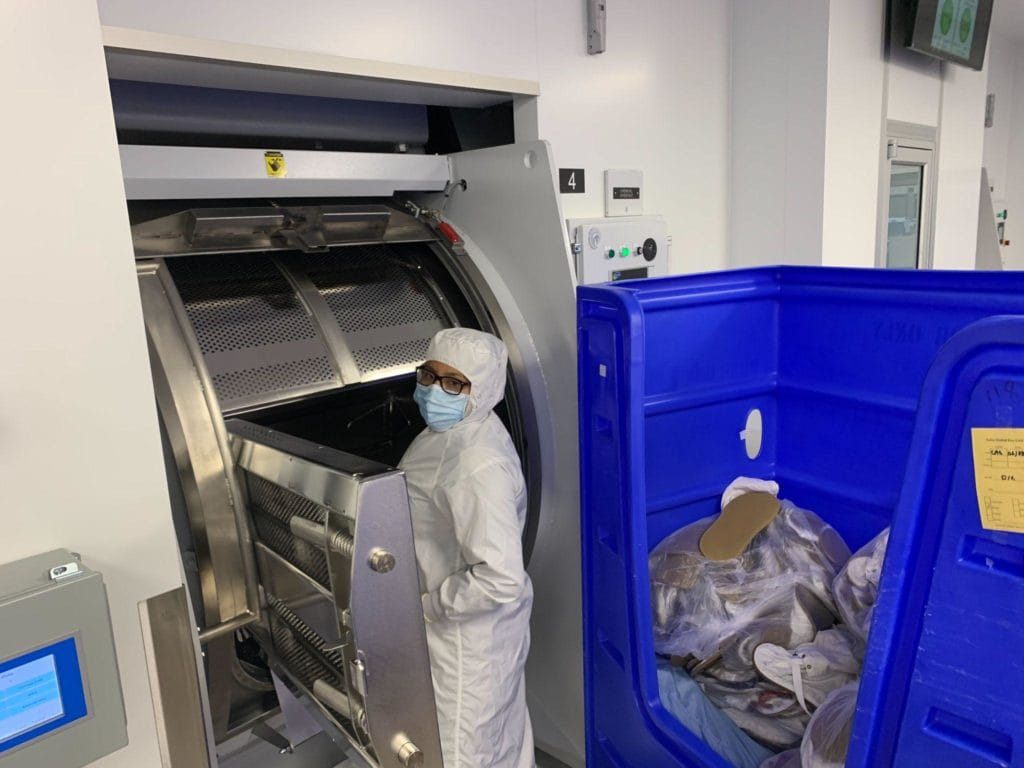
| 5. Industrial Wash | Garments washed to ISO 15797 standards (Thermal Disinfection). | Rental Provider |
| 6. Repair/Replace | Damaged zippers/buttons fixed automatically. | Rental Provider |
| 7. Return | Clean garments placed directly in worker’s locker. | Rental Provider |
Key Difference: The "Safety Stock" sits at the Rental Provider’s mega-warehouse, not on your balance sheet.
3. Sector-Specific Wins: Food vs. Logistics
The value proposition changes depending on the industry.
A. Large Food Plants (HACCP / BRC Focus)
- The Problem: Cross-contamination. A single hair or pathogen can trigger a recall.
- The Rental Solution:
- Barrier Washing: Dirty and Clean zones are physically separated in the laundry.
- Microbiological Testing: Rental providers test fabric for bacteria counts (RABC analysis).
- Pocket Control: Automated scanning ensures no pens or loose items enter the wash.
- Inventory Benefit: "Pool Stock" (non-personalized) white coats allow flexible staffing without measuring every temp worker.
B. Logistics & Distribution (Turnover Focus)
- The Problem: High staff turnover (30%+). Issuing a new $100 uniform kit to a temp who quits in 3 weeks is a waste.
- The Rental Solution:
- Rapid Return: When a worker quits, the uniform is returned, washed, and re-issued to the next hire.
- Pooling: Standardized uniforms allow immediate re-use.
- Inventory Benefit: You stop buying new kits. You simply rotate existing stock.
4. Financial Deep Dive: CAPEX vs. OPEX
The shift to rental is a financial restructuring of the safety budget.
| Cost Category | Ownership (Purchase Model) | Rental (Service Model) |
|---|---|---|
| Upfront Cost (CAPEX) | High. Buying 3,000 sets @ $50 = $150,000 cash outlay. | Zero. Initial stock is provided by the rental firm. |
| Laundering | Hidden Cost (Home wash) or Separate Contract. | Included in weekly fee. |
| Repairs | Often ignored until replacement is needed. | Included. Extends garment life by 30%. |
| Management Time | High. Procurement manages POs, sizes, and returns. | Low. Provider manages stock levels. |
| Tax Treatment | Depreciating Asset (Complex). | Operating Expense (100% Deductible). |
| Predictability | Spiky (Huge buys once a year). | Flat (Monthly fee based on headcount). |
5. Technology Enablers: How RFID Cuts the Fat
You cannot manage what you cannot measure. Modern rental relies on UHF RFID.
The "Smart Locker" Effect
- Without RFID: Driver drops 100 shirts. You count them manually (maybe).
- With RFID: The driver walks through a portal. The system reads 100 chips in 3 seconds.
- The Accountability: If "John Smith" hasn’t returned his dirty trousers for 3 weeks, the system flags him. The manager tells John: "Bring back the trousers, or no fresh ones."
- The Result: Zero Loss. Hoarding stops immediately because the system "sees" into the lockers.
6. Sustainability: The Green Argument for Rental
Rental is inherently greener than ownership due to economies of scale.
- Water Efficiency: Industrial tunnel washers use 5-6 liters per kg of textile. Home washing machines use 20-25 liters.
- Energy Recovery: Rental laundries use heat exchangers to recycle wastewater heat to warm incoming fresh water.
- Extended Lifespan: Professional repair (darning, patching) keeps a garment in service for 3-4 years. Home washing often destroys fabrics (bleach damage) in 1 year.
- Recycling at End-of-Life: Rental providers accumulate tons of "retired" garments, making it viable to send them to textile-to-textile recyclers. Individual companies just throw them in the trash.
7. Implementation: The Transition Roadmap
Switching from ownership to rental is a major change management project.
Phase 1: Audit & Cleanse
- Count current stock. Identify "Dead Stock" (wrong sizes).
- Sell or donate old uniforms to clear the slate.
Phase 2: The "Wearer Trial"
- Don’t just pick a catalog item. Have 20 workers wear the rental garments for 2 weeks.
- Ensure comfort. Rental garments are often polyester-rich (65/35) for durability; ensure workers accept the feel.
Phase 3: The Rollout
- Day 0: Install lockers/dispensers.
- Day 1: Employees arrive, measure up, and receive their RFID tag assignments.
- Day 7: First collection. Monitor the "Soil Return Rate" (Target: >90%).
8. Buyer Checklist: Choosing a Rental Partner
Not all rental companies are equal. Ask these questions:
- [ ] Contract Duration: Standard is 3-5 years. Can you exit early if service fails?
- [ ] Residual Value Clause: If you cancel, do you have to buy back the used garments? (Watch out for this trap).
- [ ] Loss/Ruin Charges: How much do they charge for a lost garment? Is it the full new price or a depreciated value?
- [ ] Hidden Fees: Are there "Environmental Fees," "Energy Surcharges," or "hanger fees"?
- [ ] Reporting: Do you get a monthly "Inactive Wearer Report" to stop paying for employees who have left?
9. Frequently Asked Questions (FAQ)
Q1: Is rental more expensive than buying? A: On a per-item basis, renting looks more expensive over 3 years. However, when you factor in laundry, repairs, admin time, and the elimination of lost inventory, rental usually generates a 10-15% net saving, plus the intangible value of hygiene compliance.
Q2: What if an employee loses a rental uniform? A: The company pays a "Residual Value" fee. However, RFID tracking significantly reduces loss rates compared to unmanaged ownership.
Q3: Can we put our logo on rental uniforms? A: Yes. Logos are usually heat-sealed or embroidered. Note that branded uniforms cannot be "pooled" (shared with other companies), so you may need a dedicated stock.
Q4: How flexible is the contract? A: Good contracts allow for +/- 10% inventory fluctuation without penalty to accommodate seasonal staffing spikes in logistics or food production.
10. Conclusion: Focus on Your Core Business
Large Food Plants and Logistics Centers are in the business of producing food and moving boxes—not managing a clothing warehouse.
By adopting the Workwear Rental Model, you offload the headache of inventory management to experts. You trade the chaos of "Phantom Inventory" and hoarding for the precision of RFID-tracked, professionally laundered, just-in-time textile availability.
Cut the bloat. Guarantee the hygiene. Rent the solution.
📩 Need a Rental Feasibility Study? We can analyze your current inventory costs vs. a rental projection. Email: [email protected] 🌐 www.workwearsolutions.net China-based. Global Standards. Long-term Partners.

 Color Consistency: The Delta-E Standard and the End of the “Clown Suit” Effect2026年2月4日In the corporate world, a uniform is a brand’s […]
 Why Zippers Fail (and How We Prevent It): The Engineering of Closure Reliability2026年2月4日In the hierarchy of industrial garment components, the […]
 The Anatomy of a Seam: Engineering Durability at the Needle Point2026年2月4日In the world of industrial workwear, the fabric gets all […]
 Future Lab PPE Trends: The Convergence of Lightweight Protection & Sustainability2026年1月28日In the sterile corridors of pharmaceutical R&D, biotech […]
 Chemical Protection Classes A/B/C: The Definitive Guide to Risk-Based PPE Selection2026年1月28日In the hazardous materials (HazMat) industry, […]
 Freezer Gloves & Boots Trends: The Intersection of Thermal Physics and Grip Technology2026年1月28日In the unforgiving environment of a -30°C cold storage […]