
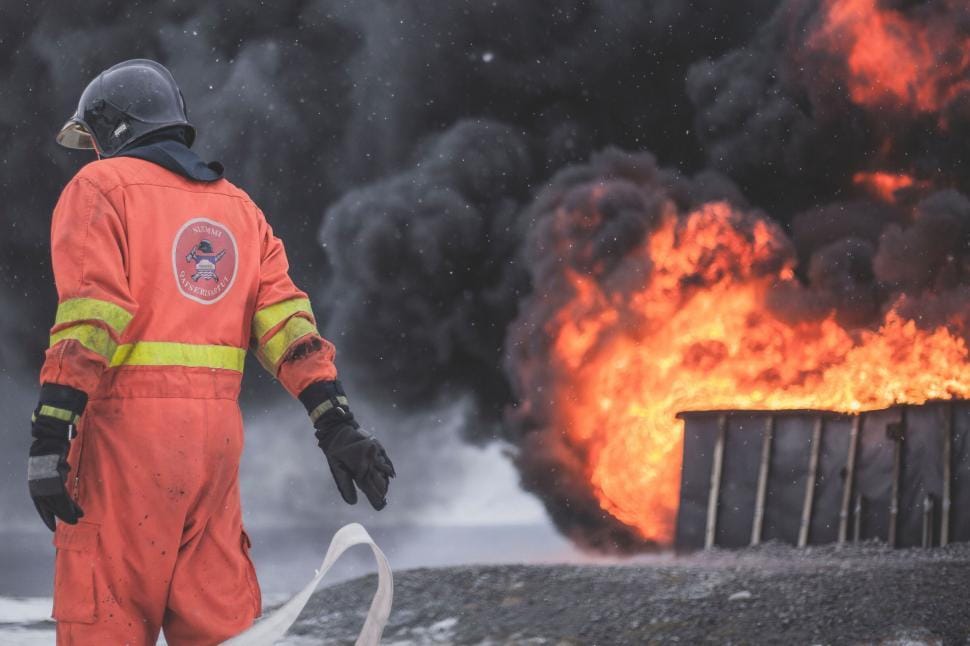
In the realm of industrial safety, few acronyms are as widely used—and as dangerously misunderstood—as FR (Flame Resistant) and AR (Arc Rated). Procurement officers and safety managers often use them interchangeably, assuming that any "fireproof" garment will protect a worker from an electrical explosion. This assumption can be fatal.
While both categories deal with thermal hazards, the physics of a hydrocarbon flash fire differ radically from the violent, plasma-driven energy of an electrical arc flash. A garment designed to withstand a 3-second refinery fire may completely fail to block the concussive energy and 19,000°C heat of a switchgear blast.
This guide combines Part 1 (The Physics of Thermal Hazards) and Part 2 (Strategic Sourcing & Risk Assessment) to provide a complete decision-making toolkit for selecting the right armor for the right threat.
Google Snippet: Quick Answer
All Arc-Rated (AR) clothing is Flame Resistant (FR), but not all FR clothing is Arc-Rated. FR acts as a self-extinguishing shield, preventing fuel-fed fires from continuing to burn the wearer (Standard: NFPA 2112 / ISO 11612). AR acts as an insulator against the specific explosive energy of an electrical fault, quantified in cal/cm² (Standard: NFPA 70E / IEC 61482). Using generic FR for electrical work leaves workers vulnerable to second-degree burns through the fabric.
1. The Physics of the Hazard: Fire vs. Explosion
To choose the right PPE, one must understand the enemy.
The Flash Fire (FR Domain)
- The Scenario: A fuel vapor cloud ignites in a refinery or chemical plant.
- The Mechanics: It is a fuel-limited fire. It engulfs the worker rapidly, burns at roughly 1,000°C (1,800°F), and typically lasts 3–5 seconds.
- The PPE Goal: Self-Extinguish. The primary job of FR clothing is to stop burning once the fuel source is removed, preventing the clothing itself from becoming fuel and reducing the total body burn percentage.
The Arc Flash (AR Domain)
- The Scenario: A short circuit in a high-voltage panel causes an electrical breakdown of air.
- The Mechanics: It is an explosion.
- Temperature: Reaches 19,000°C (35,000°F)—hotter than the surface of the sun.
- Duration: Fractions of a second (cycles).
- Forces: Generates a pressure wave (blast), blinding light, loud noise, and molten metal shrapnel.
- The PPE Goal: Insulate & Absorb. AR clothing must not only self-extinguish but also provide a measured barrier (ATPV) to prevent the intense thermal energy from causing 2nd-degree burns on the skin underneath.
2. The Standards Landscape: Reading the Label
Understanding the testing protocols clarifies the difference.
| Category | Standard | Test Method | What it Measures |
|---|---|---|---|
| FR (General) | NFPA 2112 (USA) ISO 11612 (EU) |
Manikin Test (ASTM F1930) | Exposes a sensor-laden manikin to a 3-second fire. Passes if total body burn is <50%. Pass/Fail only. |
| AR (Electrical) | ASTM F1959 (Material) IEC 61482-1-1 (Open Arc) |
Open Arc Test | Exposes fabric to a real arc flash. Determines the Arc Thermal Performance Value (ATPV) in cal/cm². Quantified Rating. |
| AR (Box Test) | IEC 61482-1-2 | Box Test | Exposes fabric to a constrained arc (4kA or 7kA). Result is Class 1 (4kA) or Class 2 (7kA). Pass/Fail. |
Critical Note: A garment with only ISO 11612 certification has NOT been tested against electrical arcs. It might survive the flame but transmit enough heat to severely burn the worker during an arc blast.
3. The "Venn Diagram" of Protection
It is essential to view these protections as a hierarchy, not a binary choice.
- Level 1: Non-FR (Cotton/Poly)
- Ignites and continues to burn. Melts into skin (Polyester). Forbidden in industry.
- Level 2: Flame Resistant (FR)
- Will self-extinguish.
- Use Case: Oil & Gas, Petrochemical, Welding.
- Limitation: No guarantee of insulation against arc energy.
- Level 3: Arc Rated (AR)
- Is inherently FR (will not burn).
- Has a specific Calorie Rating (cal/cm²).
- Use Case: Electricians, Utilities, Hybrid Vehicle Maintenance.
The Material Science: How they work
- Treated FR (FRT): Cotton fibers treated with a chemical (e.g., ammonia cure) that extinguishes fire. Good for Flash Fire, decent for low-level Arc.
- Inherent FR (Aramid/Modacrylic): The polymer structure itself resists combustion. Superior for high-level Arc because the fibers expand and carbonize (char), creating a thick, puffy shield that traps air and blocks heat.
4. Case Study Comparisons by Industry Segment
| Industry | The Hazard | Wrong Choice | Correct Framework | Outcome |
|---|---|---|---|---|
| Oil Refinery | Hydrocarbon Flash Fire. | Standard AR (low cal) that is heavy/expensive. | NFPA 2112 FR. Focus on flash fire manikin results (body burn %). | Optimized Cost. Workers protected from fire without over-paying for arc insulation they don’t need. |
| Industrial Electrician | 480V Switchgear Maintenance. | Generic ISO 11612 FR. | NFPA 70E / CAT 2 AR. Must meet min 8 cal/cm². | Survival. When a breaker failed, the AR shirt blocked the heat. The generic FR would have allowed severe skin burns. |
| EV Battery Plant | DC Arc Flash + Chemicals. | Standard Cotton. | AR + Chemical Splash. Multi-norm fabric. | Compliance. Addressed the specific high-energy DC arc hazard unique to batteries. |
| Welding | Molten Slag + UV Radiation. | High-Cal Arc Suit. | Heavy FR Leather/Cotton. | Durability. Arc suits are expensive and get ruined by slag. Welding leather is the right FR tool. |
5. Common Procurement Mistakes: The "FR Trap"
| Mistake | Impact | Prevention Tip |
|---|---|---|
| "It says FR, so it’s safe for electrical work." | The deadliest error. Generic FR has no insulation rating. The worker survives the fire but suffers 3rd-degree burns from heat transfer. | Look for the "Arc Rating" or "ATPV" tag on the neck label. If it’s not there, it’s not AR. |
| Ignoring the Calorie Count | Wearing an 8 cal/cm² shirt in a 40 cal/cm² hazard zone. | Perform an Arc Flash Risk Assessment (IEEE 1584) to determine the required energy level. |
| Incorrect Layering | Wearing a non-FR t-shirt under an AR shirt. | In a high-energy blast, the arc energy passes through the AR shirt and ignites the t-shirt underneath. Base layers must be FR/AR. |
| Confusing Weight with Protection | Thinking heavier fabric is safer. | Advanced Aramid/Modacrylic blends offer higher protection at lighter weights than old FR cotton. |
| Washing out the Protection | Using bleach or fabric softener on Treated FR garments. | Follow ASTM F1449 laundry guides. Softeners coat the fiber with flammable wax; bleach degrades the FR treatment. |
Example: A utility company in Texas issued "FR Cotton Coveralls" to linemen. During a transformer fault, the arc energy (12 cal/cm²) overwhelmed the cotton (rated roughly 7 cal/cm²).
- Result: The cotton didn’t burn, but it transferred enough heat to cause hospitalization.
- Correction: Switched to Aramid Blends (ATPV 15 cal/cm²).
6. ROI Analysis: FR vs. AR
Procurement often balks at the price difference. AR garments generally cost 20–40% more than basic FR.
Scenario: 100 Maintenance Technicians.
| Metric | Basic FR Coverall (NFPA 2112) | Dual-Certified AR/FR Coverall (CAT 2) |
|---|---|---|
| Unit Cost | $60 | $85 |
| Total Spend | $6,000 | $8,500 |
| Hazard Coverage | Flash Fire ONLY | Flash Fire + Electrical Arc |
| Risk Exposure | High (If they touch a panel) | Low (Protected everywhere) |
| Burn Injury Cost | ~$1,000,000 (ICU + Lawsuits) | ~$5,000 (Minor treatment) |
| Durability | Moderate (Cotton based) | High (Synthetic blend) |
The Verdict: If your workers ever open an electrical panel, the $25 premium for AR certification is the cheapest insurance policy you will ever buy.
7. Buyer Checklist: Specifying the Right Framework
Use this checklist to ensure your RFQ (Request for Quote) targets the correct protection.
Step 1: Identify the Hazard
- [ ] Is the primary risk fuel/fire? -> Target FR Standards (NFPA 2112 / ISO 11612).
- [ ] Is the primary risk electrical? -> Target AR Standards (NFPA 70E / IEC 61482).
Step 2: Quantify the Protection (For AR)
- [ ] Calculate the incident energy (cal/cm²).
- [ ] CAT 1: > 4 cal/cm²
- [ ] CAT 2: > 8 cal/cm² (Most common for daily wear)
- [ ] CAT 3: > 25 cal/cm²
- [ ] CAT 4: > 40 cal/cm² (Bomb suit territory)
Step 3: Verify the Comfort (Compliance)
- [ ] Weight: Is it under 7oz (230gsm) for daily wear?
- [ ] Breathability: Does it use a moisture-wicking blend?
- [ ] Design: Gusseted crotch and articulated sleeves for movement?
Step 4: Audit the Supply
- [ ] Ask for the UL Classification or Third-Party Lab Report.
- [ ] Ensure the ATPV value is permanently embroidered on the exterior (easy visual check for safety managers).
8. Frequently Asked Questions (FAQ)
Q1: Can I wear 100% Cotton for electrical work? It doesn’t melt. A: NO. While cotton doesn’t melt, it ignites easily and burns hotly. In an arc flash, untreated cotton will explode into flame, drastically increasing injury. You must use FR Treated cotton at minimum.
Q2: Does ARC protection "wear out"? A: Inherent FR/AR (Aramid) never wears out; the protection is molecular. Treated FR/AR (Cotton) is guaranteed for the "useful life of the garment" (usually 50–100 washes), provided bleach is never used.
Q3: Is a higher ATPV always better? A: Not necessarily. Higher ATPV often means heavier, hotter fabric. If your risk assessment shows max 8 cal exposure, wearing a 40 cal suit will cause heat stress. Match the rating to the risk.
Q4: What is EBT vs ATPV? A: They are both arc ratings.
- ATPV (Arc Thermal Performance Value): The point where there is a 50% probability of a 2nd-degree burn.
- EBT (Energy Break-Open Threshold): The point where the fabric breaks open (holes form).
- Rule: The label will show whichever value is lower. Both are safe ratings to use.
Q5: Can I layer two CAT 1 shirts to get CAT 2 protection? A: Generally, yes, but you must consult manufacturer data. Air gaps between layers often provide more protection than the sum of the ratings (e.g., 4 cal + 4 cal might equal 10 cal protection).
9. Conclusion
The distinction between FR (Fire protection) and AR (Electrical protection) is not just semantic; it is a matter of physics.
- FR prevents the fire from continuing.
- AR blocks the explosion from penetrating.
For the modern safety manager, the goal is Dual-Hazard Protection. By sourcing materials that carry both NFPA 2112 (Flash Fire) and NFPA 70E (Arc Flash) certifications, you ensure your workforce is armored against the unpredictable, whether it stems from a ruptured pipe or a tripped breaker.
Don’t just buy "FR". Buy the specific physics your workers need to survive.
📩 Need help navigating Arc Flash Calculations or sourcing Dual-Certified PPE? We specialize in high-performance thermal protection for utilities and heavy industry. Email: [email protected] 🌐 www.workwearsolutions.net

 Color Consistency: The Delta-E Standard and the End of the “Clown Suit” Effect2026年2月4日In the corporate world, a uniform is a brand’s […]
 Why Zippers Fail (and How We Prevent It): The Engineering of Closure Reliability2026年2月4日In the hierarchy of industrial garment components, the […]
 The Anatomy of a Seam: Engineering Durability at the Needle Point2026年2月4日In the world of industrial workwear, the fabric gets all […]
 Future Lab PPE Trends: The Convergence of Lightweight Protection & Sustainability2026年1月28日In the sterile corridors of pharmaceutical R&D, biotech […]
 Chemical Protection Classes A/B/C: The Definitive Guide to Risk-Based PPE Selection2026年1月28日In the hazardous materials (HazMat) industry, […]
 Freezer Gloves & Boots Trends: The Intersection of Thermal Physics and Grip Technology2026年1月28日In the unforgiving environment of a -30°C cold storage […]