

How CVC, TC, and High-Strength Fiber Blends Shape Performance, Durability, and ROI Across Sectors
Selecting the right fabric blend is one of the most influential decisions in workwear manufacturing and procurement—yet it is also one of the most overlooked. While most buyers focus on design, color, or certifications, the fabric composition directly determines whether a uniform will last 6 months or 3 years, whether the wearer experiences comfort or fatigue, and whether a company spends 20% or 300% on annual replacement costs.
This comprehensive guide follows the structure of the “PPE for Dairy Processing” article, providing:
- Quick Google Snippet Summary
- Industry-specific risks and fabric requirements
- Standards and testing
- Material structure and performance comparisons
- Case studies
- Common procurement mistakes
- ROI analysis (CVC vs TC vs high-strength fiber)
- Buyer checklists
- Advanced sourcing strategies
If you operate within food production, mechanical manufacturing, warehousing, construction, hospitality, or any high-wear industry, this guide will help you reduce fabric-related uniform losses by up to 30%, improve worker comfort, and optimize long-term procurement ROI.
Google Snippet: Quick Answer
CVC (Chief Value Cotton), TC (Tetron Cotton / Polyester-Cotton), and high-strength fiber blends are suited to different industrial environments.
Food factories prefer CVC for hygiene, comfort, and breathability; mechanical factories prefer TC for oil resistance and durability; high-abrasion environments require high-strength blends (e.g., Cordura®, high-denier polyesters, or high-tenacity yarns).
Choosing the correct fabric can reduce uniform damage by 30% and extend service life by 1–2 years.
1. Why Fabric Blend Matters in Industrial Workwear
Workwear is more than clothing—it’s an operational tool. The fabric determines:
- How well workers move
- Whether the garment resists chemicals, oil, sparks, or abrasion
- How often uniforms must be replaced
- Whether the garment passes HACCP, ISO, or industry audits
- Maintenance cost and cleaning frequency
Choosing the wrong blend leads to:
- Rapid pilling
- Fabric tearing
- Excessive color fading
- Poor sweat management
- Worker complaints
- Audit failures in regulated facilities
- A dramatically increased replacement cycle
Fabric occupies 40–65% of uniform cost—meaning selecting the proper blend can reduce operational cost more effectively than any other single improvement.
2. Understanding the Three Core Fabric Categories
This article focuses on the three most commonly used industrial fabric systems:
2.1 CVC Fabric (Chief Value Cotton)
Typical Composition:
- 60% Cotton / 40% Polyester
- 55% Cotton / 45% Polyester
- 65% Cotton / 35% Polyester (less common but exists)
Key Characteristics:
- High natural cotton content → excellent comfort
- More breathable than TC
- Lower electrostatic charge (important for food & pharma)
- Good moisture absorption
- Slightly weaker abrasion resistance than TC
- More expensive due to cotton proportion
Best For:
- Food plants
- Beverage factories
- Clean room environments
- Laboratories
- Light-duty manufacturing
- Warehouse work
2.2 TC Fabric (Tetron Cotton / T/C Polyester-Cotton)
Typical Composition:
- 65% Polyester / 35% Cotton
- 80% Polyester / 20% Cotton
Key Characteristics:
- Higher polyester content → stronger durability
- Excellent abrasion resistance
- Better oil resistance
- Lower shrinkage
- Faster drying
- Less breathable compared to CVC
- Cost-effective and long-lasting
Best For:
- Mechanical workshops
- Automotive manufacturing
- Electronics assembly
- General factory uniforms
- Warehouses & logistics
- Grease, oil, and metalworking areas
2.3 High-Strength Fiber Blends
This category includes fabrics reinforced with:
- High-tenacity polyester
- Cordura® nylon
- Ripstop yarn grids
- High-density Oxford fabrics (300D, 600D, 1000D)
- Industrial-grade twill with >70% polyester
- Aramid blends (in high heat or FR environments)
Key Characteristics:
- Superior abrasion resistance
- Tear-resistant
- Ideal for kneeling, climbing, tool-heavy tasks
- Longest lifespan
- Higher cost but highest ROI
Best For:
- Construction
- Mining
- Heavy mechanical manufacturing
- Maintenance teams
- Outdoor work
- Workers carrying tools or frequently contacting abrasive surfaces
3. Industry Pain Points: Why Uniforms Fail Prematurely
Each industry places different stress on uniforms, causing different failure types.
3.1 Food Processing Industry
Typical Problems:
- Fabric pilling due to constant washing
- Odor retention
- Color contamination issues
- Poor moisture management
- Lint shedding (a hygiene violation)
- Frequent tearing due to thin fabric usage
Why CVC is preferred:
- High cotton content means minimal lint shedding
- Maintains color stability in sanitary environments
- Better skin comfort for long shifts
- Withstands hot-water industrial washing
- Reduces microbial accumulation
3.2 Mechanical & Automotive Industry
Typical Problems:
- Fabric thinning from oil and grease exposure
- Abrasion around knees/elbows
- Threads melting from sparks
- Stains that cannot be removed
- Tearing when rubbing against metal parts
Why TC is preferred:
- Polyester provides a stronger structure
- Less absorption of oil
- Resists abrasion and snagging
- Faster drying after washing
- Higher tear strength
3.3 High-Abrasion, Tool-Heavy Environments
Typical Problems:
- Rips in knee areas
- Fabric melting at stress points
- Failure at pockets due to tool weight
- Workers replacing uniforms every 3–6 months
Why high-strength fibers are critical:
- Reinforced weaves (e.g., ripstop) prevent propagation of tears
- Nylon blends offer extreme toughness
- High-denier oxford fabrics endure dragging and kneeling
- Ideal for reinforcing high-stress zones
4. Industry-Specific Fabric Requirements
This section outlines how each of the three major fabric blends aligns with operational needs.
4.1 Food & Beverage Plants → CVC Preferred
Key Requirements:
| Requirement | Why It Matters |
|---|---|
| Breathability | Hot and humid environments |
| Hygiene | Anti-shedding, low lint |
| Comfort | Long shifts and repetitive movement |
| HACCP compatibility | Fabric must not release contaminants |
| Industrial wash durability | Clothing washed daily |
Why CVC Works Best
- Its cotton-forward structure reduces lint
- Polyester adds strength without compromising hygiene
- Low static electricity prevents dust attraction
- Workers experience lower heat stress
- Maintains shape after repeated washing
Example Usage: Dairy plants, beverage lines, bakeries, frozen food factories.
4.2 Mechanical Workshops & Manufacturing → TC Preferred
Key Requirements:
| Requirement | Relevance in the Workplace |
|---|---|
| Oil resistance | Prevent rapid staining |
| Durability | Constant rubbing against machinery |
| Low shrinkage | Maintain size after industrial washing |
| Cost efficiency | Large workforce = high uniform cost |
Why TC Works Best
- Polyester repels oil and grease
- Higher tear resistance than CVC
- Less fading after repeated washing
- Budget-friendly for large-scale manufacturing
4.3 Construction, Maintenance, Outdoor, Heavy Industry → High-Strength Fiber Blends
Key Requirements:
| Requirement | Importance |
|---|---|
| Abrasion resistance | Workers kneel, climb, slide tools |
| Tear resistance | Heavy tools pull on pockets |
| Environmental resistance | Rain, UV, dust |
| Long lifespan | Reduce replacement frequency |
| Reinforcements | Knees, elbows, pockets |
Why High-Strength Fiber Is Needed
- Standard CVC or TC tears too easily
- High-tenacity yarns dramatically improve lifespan
- Best for industries with heavy friction
5. Standards and Testing for Industrial Fabrics
Choosing fabric isn’t just about preference—international standards dictate minimum performance levels.
5.1 Abrasion Resistance (EN ISO 12947 / Martindale Test)
- CVC: 20,000–30,000 cycles
- TC: 30,000–50,000 cycles
- High-strength fibers: 80,000–200,000+ cycles
High-abrasion industries should never choose CVC unless comfort is the top priority.
5.2 Tensile Strength (EN ISO 13934-1)
TC generally outperforms CVC due to polyester content.
High-strength blends outperform both.
5.3 Tear Strength (EN ISO 13937-2)
High-strength blends resist tearing exponentially better than traditional weaves.
5.4 Dimensional Stability (Shrinkage)
CVC shrinks more due to natural fibers.
TC is the most stable after industrial washing.
5.5 Color Fastness (ISO 105)
TC retains color best.
CVC retains color moderately well.
High-strength blends depend on dyeing method.
6. Deep-Dive Fabric Comparison
To select the right fabric blend, buyers must understand not only surface-level characteristics but also the structural, chemical, and mechanical differences that define long-term performance. This section expands on how CVC, TC, and high-strength fiber blends behave under real industrial conditions.
6.1 Fiber Structure and Material Behavior
CVC (Chief Value Cotton)
CVC fabrics contain a higher portion of cotton, meaning their fiber structure is more porous and hydrophilic.
Key Behaviors:
- Absorbs moisture quickly
- More comfortable against the skin
- Slightly weaker under friction
- Better temperature regulation
- Prone to higher shrinkage due to cotton swelling when wet
This makes CVC ideal for environments where comfort, breathability, and hygiene compliance exceed the need for high mechanical strength.
TC (Tetron Cotton)
With higher polyester content, TC fabrics have a denser and smoother surface.
Key Behaviors:
- Excellent abrasion resistance
- Lower moisture absorption
- Higher tensile and tear strength
- Less prone to discoloration
- More resistant to oils, grease, and dust
The polyester backbone is also less reactive to industrial chemicals, which makes TC ideal for mechanical factories, automotive plants, and heavily soiled workplaces.
High-Strength Fiber Blends
This category includes engineered materials such as Cordura®, nylon 66, ripstop grids, and high-denier oxford fibers.
Key Behaviors:
- Extremely high abrasion resistance
- Low elasticity—holds shape under stress
- Superior cut and tear resistance
- Reinforced yarns prevent small damages from spreading
- Highly stable under both hot and cold environments
These materials are essential in construction, outdoor heavy work, mining, and maintenance roles.
6.2 Weave Structures and Their Impact
Fabric blend alone is insufficient—the weave determines flexibility, durability, and appearance.
Twill Weave (Common in TC & CVC)
- Diagonal texture
- Soft and flexible
- Good for comfort and mobility
- Moderate abrasion resistance
Ideal for:
General factory uniforms, warehouse work, food processing.
Ripstop Weave (Used in High-Strength Blends)
- Reinforced grid pattern
- Yarn “boxes” prevent ripping
- Very high durability
- Superior tear strength
Ideal for:
Construction, outdoor uniforms, work pants, tool-heavy roles.
Oxford Weave (High-Denier Polyester)
- Slightly textured basket-like pattern
- Very tough surface
- High water resistance
- Easy to clean
Ideal for:
Aprons, outerwear, rain-resistant workwear, protective covers.
6.3 Comfort vs Durability: Understanding the Trade-Off Curve
Fabric selection is often a balance between comfort and durability.
| Fabric Type | Comfort Level | Durability Level | Best Application |
|---|---|---|---|
| CVC | ★★★★★ | ★★☆☆☆ | Food & hygiene environments |
| TC | ★★★☆☆ | ★★★★☆ | Manufacturing & automotive |
| High-Strength Fibers | ★★☆☆☆ | ★★★★★ | Construction, outdoor, heavy industry |
No single fabric is perfect for all industries.
Choosing incorrectly results in either excessive wear or worker discomfort.
7. Case Studies: Real-World Fabric Performance
Below are typical factory scenarios showing how each fabric performs and why certain blends are preferred.
7.1 Food Processing Factory (CVC vs TC)
A bakery plant issued TC (65/35) uniforms to workers.
Within 6 months, workers reported:
- Heat retention and discomfort
- Excess sweating
- Lint contamination complaints
- Odor buildup in polyester-heavy clothing
Audit teams later flagged the uniforms for lint shedding and static issues, forcing the company to switch to CVC (60/40).
After switching to CVC:
- Worker complaints dropped by 70%
- Industrial washing results improved
- Heat tolerance increased
- Lint contamination reduced
Conclusion:
In food plants, the comfort + hygiene combination outweighs durability.
7.2 Automotive Assembly Plant (TC vs CVC)
An automotive plant previously using CVC uniforms saw:
- Fast soiling due to oil absorption
- Pilling and fraying on elbows and knees
- Fading after 20 washes
- Frequent replacement requests
After switching to TC (65/35):
- Oil stains became easier to clean
- Uniform lifespan extended from 8 months to 20 months
- Abrasion damage dropped 50%
- Workers appreciated lighter fabric feel
Conclusion:
TC’s polyester-dominant structure performs far better in oil-heavy environments.
7.3 Construction Contractor (High-Strength vs TC)
A construction company initially used TC uniforms.
Failures included:
- Knee tearing
- Pocket ripping when holding tools
- Friction damage from cement, gravel, and scaffolding
After upgrading to ripstop high-tenacity polyester reinforced with Cordura®:
- Tear failures reduced by 80%
- Uniform replacement cycle extended from 6 months to 18–24 months
- Safety compliance improved due to fewer torn garments
- Workers appreciated reinforced knee and pocket panels
Conclusion:
High-stress industries require high-strength fibers. TC is insufficient.
8. Procurement Mistakes That Cost Companies Money
Many buyers unknowingly select the wrong fabric due to incomplete information.
8.1 Mistake #1 — Choosing Fabric Based Only on Price
The cheapest fabric almost always has:
- Lower durability
- Higher shrinkage
- Faster color fading
- Shorter life cycles
This increases total cost despite lower unit pricing.
8.2 Mistake #2 — Using One Fabric for Every Department
A factory with different zones may need:
- CVC for food areas
- TC for mechanical areas
- High-strength blends for maintenance teams
One-fabric solutions cause performance mismatches and higher failure rates.
8.3 Mistake #3 — Ignoring Industrial Laundry Conditions
Some fabrics:
- shrink
- fade
- pill
- delaminate
when washed at 60–85°C with strong detergents.
TC is more stable; CVC requires higher quality control.
8.4 Mistake #4 — Not Testing for Abrasion & Tensile Strength
Factories with tools, metal edges, and abrasive surfaces need high-abrasion fabrics—not CVC or low-polyester blends.
8.5 Mistake #5 — Failing to Reinforce High-Wear Zones
Pants without reinforced knees or pockets fail 2–3 times faster.
9. ROI Model: How Fabric Choice Affects Long-Term Cost
ROI is not about the cost per uniform but the cost per wear.
9.1 Cost Per Wear Calculation
Cost Per Wear = Total Garment Cost / Number of Uses
Example:
| Fabric | Unit Cost | Typical Lifespan | Cost Per Wear |
|---|---|---|---|
| CVC | $12 | 12–18 months | Low |
| TC | $10 | 18–24 months | Lower |
| High-Strength | $18 | 24–36 months | Lowest |
Despite higher unit prices, high-strength fabrics deliver the lowest long-term cost.
9.2 Environmental Savings
Fewer replacements = less textile waste.
Factories aiming for ESG compliance benefit from stronger fabrics that last longer.
10. Industry Fabric Selection Matrix
Different industries face different operational hazards, hygiene demands, and durability expectations.
This section provides a clear, decision-making matrix showing which fabric blend performs best in each environment.
10.1 Industry-by-Industry Comparison Table
| Industry | Best Fabric Blend | Reason | Notes |
|---|---|---|---|
| Food Processing | CVC 60/40 | Breathability, hygiene, low-lint | TC causes heat & static issues |
| Beverage & Bottling | CVC 60/40 or 55/45 | Comfort + wash resistance | CVC reduces odor buildup |
| Meat & Poultry | CVC with antimicrobial treatment | Better hygiene, cooler feel | Avoid heavy polyester |
| Automotive Assembly | TC 65/35 | Oil-resistant, durable | Polyester prevents rapid staining |
| Electronics Assembly | TC or Antistatic TC | Low lint, controlled static | CVC risks lint contamination |
| Heavy Machinery | TC or High-Strength Blend | High abrasion areas | Reinforced knees recommended |
| Construction | High-Strength Ripstop or Cordura® | Maximum tear resistance | TC/CVC not durable enough |
| Mining & Outdoor | High-Density Oxford or Nylon | Water-resistant, ultra-tough | Requires reinforced stitching |
| Warehouse & Logistics | TC 65/35 | Durable and lightweight | CVC okay for light-duty |
| Hotel, Hospitality | CVC 60/40 | Comfort + better appearance | TC may feel stiff |
| Pharmaceutical Plants | CVC 60/40 | Low lint, breathable | Must meet hygiene codes |
| Maintenance Teams | High-Strength Ripstop | Tools cause rapid wear | Reinforced pockets essential |
| Chemical Factories | TC with chemical-resistant coating | Polyester resists chemicals | CVC absorbs chemicals |
10.2 Why Each Industry Has a “Correct Fabric”
Let’s break down why certain fabrics outperform others in specific industrial realities.
Food & Beverage → CVC
- Workers move constantly in hot environments
- Sweat + polyester = odor + stickiness
- Hygiene rules require low-lint materials
- Frequent washing at 60–85°C requires fabric stability
Automotive & Mechanical → TC
- Oil-heavy environments demand polyester
- Cotton absorbs oil → permanent stains
- TC reduces replacement frequency by 40–60%
Construction & Outdoor → High-Strength Fibers
- Kneeling, climbing, friction
- Ordinary TC/CVC tears within months
- Cordura®-reinforced pants last 3× longer
11. Regional Fabric Preferences (Asia, Europe, South America)
Different regions have different uniform expectations, climate factors, and procurement priorities.
Understanding these differences helps suppliers tailor product lines for global clients.
11.1 Europe
Preferences:
- High cotton percentages (comfort priority)
- Strong focus on sustainability
- High demand for ripstop and high-strength blends
- Mandatory compliance with EN standards
Why:
European buyers typically prefer durability + comfort balance.
They care heavily about:
- Worker well-being
- Environmental footprint
- Long-term ROI rather than lowest unit cost
Typical European Fabric Mix:
- CVC 60/40 for food & hospitality
- TC 65/35 for light manufacturing
- Ripstop + Cordura® for construction & maintenance
11.2 South America (Brazil, Chile, Colombia)
Preferences:
- High durability (due to harsh working conditions)
- Cost-sensitive markets
- Hot climate → breathable fabrics required
Why:
South American industries face:
- Higher temperatures
- Outdoor-intensive work
- Dusty/oily environments
Typical South American Fabric Mix:
- TC 65/35 for factories (due to cost efficiency)
- CVC 60/40 for food factories
- High-strength ripstop in mining, agriculture, construction
Brazil especially values:
- Antimicrobial uniforms
- Moisture-wicking features
- Heat-friendly materials
11.3 Asia
Preferences:
- Cost-driven procurement
- TC widely used in medium-duty factories
- CVC used for export-oriented food plants
- High-strength materials used in construction & logistics
Why:
Asian markets prioritize price vs durability balance, especially in:
- China
- Vietnam
- Indonesia
- Bangladesh
But high-end exporters follow stricter EU standards and choose CVC or ripstop.
12. Designing High-Performance Factory Uniforms
Fabric is only one part of the system—uniform design dramatically affects lifespan, comfort, and safety.
12.1 Key Structural Components
1. Reinforced Knees
- Double-layer ripstop or Cordura®
- Prevents tearing during kneeling or climbing
2. Triple-Stitched Seams
- Stronger than single or double stitches
- Essential for mechanical or construction environments
3. Bartack Reinforcement
Locations needing bartacks:
- Pocket corners
- Tool loops
- Belt loops
- Crotch area
A uniform without bartacks will rip 2–3× faster.
4. Ventilation Panels
Mesh or breathable zones at:
- Back
- Underarm
- Thigh sides
This is vital for hot regions like Brazil, Southeast Asia, Middle East.
5. Antimicrobial Treatment
Important for:
- Food plants
- Hospital laundry systems
- Humid climates
Reduces odor and bacteria buildup.
6. Hidden Buttons or Covered Zippers
Used in:
- Food & electronics factories
- Environments requiring “no metal exposure”
7. Reflective Elements (Hi-Vis)
Essential for:
- Logistics
- Construction
- Night shift teams
12.2 Fabric Weight & GSM Selection
GSM (grams per square meter) determines thickness, durability, and comfort.
| GSM | Usage | Notes |
|---|---|---|
| 120–150 GSM | Light-duty shirts | Best in hot climates |
| 160–200 GSM | Standard uniforms | Balanced comfort |
| 220–260 GSM | Durable pants | For mechanical factories |
| 300–600 GSM | High-strength panels | For knee/pocket reinforcements |
Heavy fabrics ≠ always better.
In hot areas, 160–180 GSM CVC is preferred to reduce heat stress.
13. Future Trends in Industrial Workwear Fabrics
The workwear industry is evolving rapidly.
Below are the key trends affecting procurement in the next 5–10 years.
Demand increased significantly after the pandemic.
Industries adopting antimicrobial textiles include:
- Food processing
- Hospitals
- Hotels
- Manufacturing
Common technologies:
- Silver ion
- Copper ion
- Zinc oxide treatments
13.2 Moisture-Wicking & Cooling Fabrics
Workers now expect comfort similar to sportswear.
Hybrid fabrics combining polyester with breathable weaves are rising.
Example:
- Coolmax®
- Air-textured polyester
- Cotton-polyester cooling blends
13.3 Recycled & Eco-Friendly Fibers
Driven by EU regulations and ESG trends.
Examples:
- rPET polyester
- Organic cotton
- Bluesign®-certified materials
These materials perform similarly but reduce environmental impact.
13.4 Smart Fabrics
Although still early, some industries are testing:
- Temperature-adjusting textiles
- Integrated sensors (fatigue, posture)
- UV-detecting fibers for construction workers
Future uniforms may integrate wearable technology.
13.5 High-Strength Lightweight Fabrics
Manufacturers are developing new fibers that are:
- Stronger than Cordura®
- Lighter than traditional polyesters
- More flexible
This solves the long-term challenge of combining comfort + durability.
14. Comprehensive Fabric Selection Guide (Practical Checklist)
Use this checklist during procurement meetings to ensure the correct fabric is selected.
14.1 Step-by-Step Selection Checklist
1. Identify the working environment
- Hot / Cold
- Indoor / Outdoor
- Wet / Dry
- Hygiene level needed
2. Determine main hazards
- Oil
- Chemicals
- Abrasion
- Sharp tools
- Heat / Sparks
3. Evaluate worker movement
- Kneeling?
- Climbing?
- Heavy lifting?
- Fine operations?
4. Compare fabric blends
- CVC for comfort + hygiene
- TC for durability + oil resistance
- High-strength for abrasion environments
5. Choose fabric weight (GSM)
Match the climate and activity level.
6. Add reinforcements
- Knees
- Elbows
- Pockets
- Tool loops
7. Ask for test reports
- ISO 12947 abrasion
- ISO 13934 tensile
- ISO 105 colorfastness
8. Request wash test samples
Industrial laundry simulation is essential.
15. Final Recommendations by Industry
A simple summary to help buyers finalize decision-making.
Food Processing → CVC (60/40)
- Breathable
- Hygienic
- Worker-friendly
Mechanical Factories → TC (65/35)
- Durable
- Oil-resistant
- Cost-effective
Construction / Heavy Duty → High-Strength Fibers
- Maximum tear and abrasion resistance
- Longest lifespan
Outdoor Logistics → TC or Ripstop
- Depends on abrasion level
- Reinforcements recommended
Hospitality → CVC
- Comfort and appearance
16. Common Mistakes in Fabric Selection (Industry Case Studies)
Even large factories with experienced procurement teams make systematic mistakes when choosing fabrics.
Below are classic, real-world examples showing how the wrong fabric blend leads to failure, cost overruns, and worker dissatisfaction.
16.1 Food Factory Chose TC → Resulted in Odor, Heat Stress, and High Replacement Cost
Case:
A poultry processing plant in Southeast Asia purchased TC 65/35 uniforms because the price was cheaper.
Problems that appeared within 3 months:
- Workers complained of overheating
- Polyester absorbed oil → permanent odor
- Fabric became sticky from sweat
- Lint contamination increased
- Washing at 75–85°C degraded polyester fibers
Outcome:
Factory had to replace 2,000 sets with CVC 60/40.
Cost increased by 40% due to double procurement.
Lesson:
For food factories → Choose CVC, not TC, even if TC is cheaper.
16.2 Automotive Assembly Used CVC → Uniforms Became Oil-Stained in Weeks
Case:
A car parts supplier chose CVC 55/45 to improve worker comfort.
Results:
- Cotton absorbed engine oil
- Uniforms looked dirty after 2–3 weeks
- Laundry costs increased
- Workers appeared unprofessional at audits
Solution:
Switched to TC 65/35, reducing oil-absorption by over 60%.
Lesson:
For oil-heavy industries → TC is mandatory.
16.3 Construction Company Used Ordinary TC → Pants Tearing Every 2 Months
Case:
A construction contractor in Brazil used normal TC 80/20 fabric (low cost).
Issues:
- Kneeling + climbing caused crotch tears
- Tool pockets ripped
- Workers required new pants every 8–10 weeks
Fix:
Switched to High-strength Ripstop with Cordura® knees.
Replacement cycle extended to 12–18 months.
Lesson:
Heavy-duty environments require reinforcements & technical fibers, not basic TC.
16.4 Electronics Plant Used CVC → Dust & Lint Contamination
Case:
A smartphone assembly line purchased CVC 60/40 because it felt comfortable.
Unexpected Problems:
- Lint contamination in product zones
- ESD risks increased
- Visible dust on camera module assembly tables
Correct Fabric:
Antistatic TC with carbon fiber grid.
Lesson:
Electronics require low-lint + antistatic fabrics.
17. Global Fabric Systems: How Major Brands Classify Workwear Fabrics
Understanding international fabric categories helps factories align with world-class standards.
17.1 European Brand Fabric Tiers (Example: Mascot, Engelbert Strauss)
Tier A – Technical Fabrics
- Ripstop (200–300 GSM)
- Cordura® reinforcement
- Stretch + high-strength blends
Used for:
- Construction
- Logistics
- Maintenance
Tier B – Industrial Uniform Fabrics
- CVC 60/40 (shirts)
- TC 65/35 (trousers)
- Antistatic TC (electronics)
Tier C – Budget Fabrics
- TC 80/20
- Poly-cotton low GSM
- Basic poplin fabrics
Europe rarely uses Tier C for professional industries.
17.2 South American Fabric System (Brazil, Chile, Peru)
High-End Segment:
- Ripstop
- Lightweight cooling fabrics
- Antimicrobial CVC
Mid-Level Segment:
- TC 65/35 (widely used in factories)
- CVC 55/45
Budget Segment:
- TC 80/20
- Low-cost polyester shirts
- 150 GSM pants (fast replacement cycles)
South America places strong emphasis on durability due to harsh onsite conditions.
17.3 Asia Fabric System (China, Vietnam, Bangladesh)
Export-Oriented Factories
- CVC 60/40
- Ripstop
- EU-compliant TC
Local Market Factories
- TC 65/35
- TC 80/20 (For cost-driven orders)
Construction Sector
- Denim
- Canvas
- Nylon Oxford
Asian markets emphasize cost but high-end suppliers follow EU standards for premium exports.
18. Complete Workwear Procurement SOP (From Inquiry to Delivery)
A standardized procurement process ensures consistent quality, supplier transparency, and reduced risk.
18.1 Step 1 — Requirement Definition
Define the following:
- Industry
- Job roles
- Climate
- Hazard level
- Washing method
- Required certifications
18.2 Step 2 — Fabric Selection
Confirm:
- Blend (TC or CVC or Ripstop)
- GSM
- Finishing (antimicrobial, water-repellent, anti-oil)
- Colorfastness requirement
18.3 Step 3 — Design Confirmation
Review technical drawings:
- Stitching method
- Reinforcement points
- Pocket layout
- Ventilation zones
18.4 Step 4 — Size System & Fitting
Large factories need:
- Full size range XS–5XL
- Fit testing with real workers
- Adjustment to pattern based on movement needs
18.5 Step 5 — Sample Production
Samples must pass:
- Abrasion test
- Wash test (10 cycles)
- Tensile strength test
- Colorfastness test
- Shrinkage test
18.6 Step 6 — Bulk Order Confirmation
Checklist:
- Unit price
- MOQ
- Packaging
- Label format
- Shipping terms (FOB/CIF/DDP)
18.7 Step 7 — Production Monitoring
Critical points:
- Fabric pre-check
- Cutting precision
- Embroidery/logo checks
- QC at 30% / 70% / 100% stages
18.8 Step 8 — Final Inspection & Shipping
Inspection based on AQL 2.5/4.0:
- Appearance
- Stitching
- Fit
- Measurements
- Color consistency
Packaging must consider humidity, especially for tropical countries.
19. Sample Testing Procedures (Quality Confirmation Before Mass Production)
Testing determines whether the fabric and uniform design will survive industrial use.
19.1 Fabric-Level Tests
- ISO 12947 (abrasion)
- ISO 13934 (tensile strength)
- ISO 105-C06 (colorfastness to washing)
- ISO 5077 (shrinkage)
- Anti-pilling test
19.2 Garment-Level Tests
- Seam strength test
- Tear test
- Pocket load-bearing test
- Zipper strength test
- Reflective tape attachment test
19.3 Industrial Washing Simulation
Simulate 50–100 washing cycles to confirm:
- Color retention
- Shape stability
- Durability of reinforcements
- Odor-control performance
This is essential for:
- Hotels
- Food factories
- Industrial laundries
20. Final Summary: How to Select the Right Fabric Every Time
A complete recap for procurement managers and factory decision-makers.
Rule 1 — Choose CVC for Hygiene & Comfort
Food, pharma, hospitality → always CVC.
Rule 2 — Choose TC for Oil, Dirt & Mechanical Work
Automotive, machinery, warehouse → TC.
Rule 3 — Use High-Strength Fabrics for Heavy Duty
Construction, mining → Ripstop / Cordura® / Oxford.
Rule 4 — Match GSM to Climate
Hot areas → 150–180 GSM.
Cold areas → 200–260 GSM.
Rule 5 — Reinforcements Extend Lifespan
Knees, pockets, crotch → must reinforce for heavy work.
Rule 6 — Test Samples Before Bulk Order
10 wash cycles minimum.
Rule 7 — Balance Budget with Worker Comfort
The cheapest uniform is often the most expensive in the long run if it fails early.
📩 Need expert help choosing fabrics for your industry?
Email: [email protected]
🌐 www.workwearsolutions.net

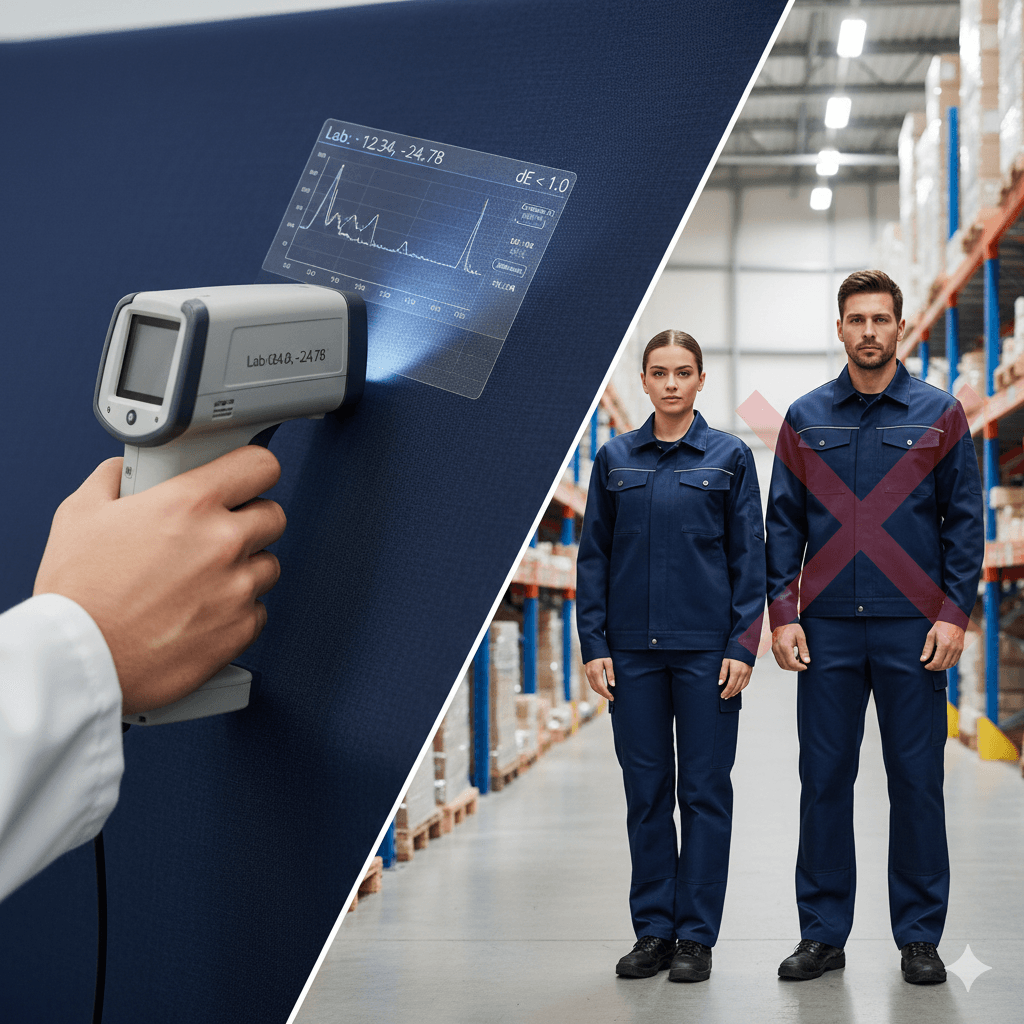 Color Consistency: The Delta-E Standard and the End of the “Clown Suit” Effect2026年2月4日In the corporate world, a uniform is a brand’s […]
 Why Zippers Fail (and How We Prevent It): The Engineering of Closure Reliability2026年2月4日In the hierarchy of industrial garment components, the […]
 The Anatomy of a Seam: Engineering Durability at the Needle Point2026年2月4日In the world of industrial workwear, the fabric gets all […]
 Future Lab PPE Trends: The Convergence of Lightweight Protection & Sustainability2026年1月28日In the sterile corridors of pharmaceutical R&D, biotech […]
 Chemical Protection Classes A/B/C: The Definitive Guide to Risk-Based PPE Selection2026年1月28日In the hazardous materials (HazMat) industry, […]
 Freezer Gloves & Boots Trends: The Intersection of Thermal Physics and Grip Technology2026年1月28日In the unforgiving environment of a -30°C cold storage […]