
Executive Summary
In the global industrial workwear and Personal Protective Equipment (PPE) sector, fabric shrinkage is frequently dismissed as a minor nuisance or an unavoidable byproduct of commercial laundering. This is a critical, multi-million-dollar misconception. When a standard 100% cotton or poly-cotton blend coverall shrinks by 5% to 8%, it does not merely become uncomfortable; it undergoes a catastrophic failure of ergonomic safety and compliance. Sleeves retract to expose wrists to thermal and chemical hazards, inseams shorten to create severe mobility restriction (crotch-binding), and the overall physical stress on seams leads to premature rupture.
This white paper forensically deconstructs the structural mechanics of cellulosic fiber shrinkage, the rigorous thermodynamic engineering of the Sanforization process, and the Total Cost of Ownership (TCO) implications for procurement officers. By moving away from budget garments that rely on deceptive "pre-washed" marketing and mandating true mechanical compressive shrinkage (Sanforization), safety directors can stabilize their supply chain, eliminate replacement spikes, and guarantee uncompromising compliance with international safety directives.
Google Snippet: Quick Answer
Why do budget workwear garments shrink 5-8% while engineered industrial PPE maintains strict 1-3% tolerances? The secret is Sanforization—a highly controlled mechanical pre-shrinking process utilizing thermodynamic conditioning, moisture, and extreme physical compression. By forcibly compressing the warp and weft yarns before the fabric is cut and sewn, dimensional stability is permanently locked into the textile matrix. This prevents structural relaxation after heavy industrial laundering, thereby extending the garment’s operational lifecycle, protecting wearer mobility, and ensuring continuous compliance with ISO and NFPA safety standards.
1. The Physics and Mechanics of Fabric Shrinkage
To understand how to prevent shrinkage, procurement engineers must first understand the tribology and physics of why fabrics fail dimensionally. The phenomenon of shrinkage in woven cellulosic fabrics (like cotton) and standard blends is driven by two distinct mechanisms: Relaxation Shrinkage and Progressive (Felting) Shrinkage.
The Tension of Manufacturing
During the yarn spinning, warping, and weaving processes, fibers are subjected to immense longitudinal stress. Weaving looms operate under extremely high tension to tightly pack the weft yarns across the warp yarns. Furthermore, during wet finishing processes (dyeing, bleaching), fabrics are pulled continuously through the machinery. Consequently, the fabric is delivered in a highly stretched, artificially elongated state. The internal hydrogen bonds within the cellulose molecules are locked into this strained configuration.
The Thermal and Kinetic Shock of Laundering
When a garment enters an industrial washing cycle (typically 60°C to 85°C for heavy soil removal), it is subjected to water, thermal energy, chemical alkalis, and kinetic agitation.
- Hydrophilic Expansion: Cotton is highly hydrophilic. Water penetrates the fiber matrix, causing the yarns to swell radially (up to 20% in diameter).
- Path Shortening: Because the yarns swell and become thicker, they require a longer path to weave over and under one another. This geometric shift causes the fabric to pull inward—reducing its overall length and width.
- Hydrogen Bond Release: The heat and moisture break the strained hydrogen bonds formed during weaving. The stretched polymers release their kinetic potential energy and aggressively return to their natural, relaxed state.
The Operational Impact: In an un-engineered garment, this relaxation results in a 5% to 8% reduction in dimensions. On a standard Size Large coverall with a 32-inch inseam, an 8% shrinkage translates to a loss of over 2.5 inches. This exposes the worker’s ankles to sparks, biological agents, or chemical splash, instantly voiding safety compliance.
2. Relevant Global Standards for Dimensional Stability
Procurement professionals must rely on standardized testing methodologies rather than vague supplier promises. Below are the definitive global standards governing dimensional stability in industrial textiles.
| Standard Designation | Description | Acceptable Tolerance (Engineered PPE) |
|---|---|---|
| EN ISO 5077 | Determination of dimensional change in washing and drying. | < ±3% (Warp and Weft) |
| EN ISO 15797 | Industrial washing and finishing procedures for testing of workwear. | < ±3% after 50 cycles |
| AATCC TM135 | Dimensional Changes of Fabrics after Home Laundering (US Market). | < ±2% |
| ISO 6330 | Domestic washing and drying procedures for textile testing. | < ±3% |
| NFPA 2112 | Flame-resistant garments for protection of industrial personnel. | Shrinkage must not compromise thermal overlap protection. |
3. Material/Engineering Solution: The Sanforization Process
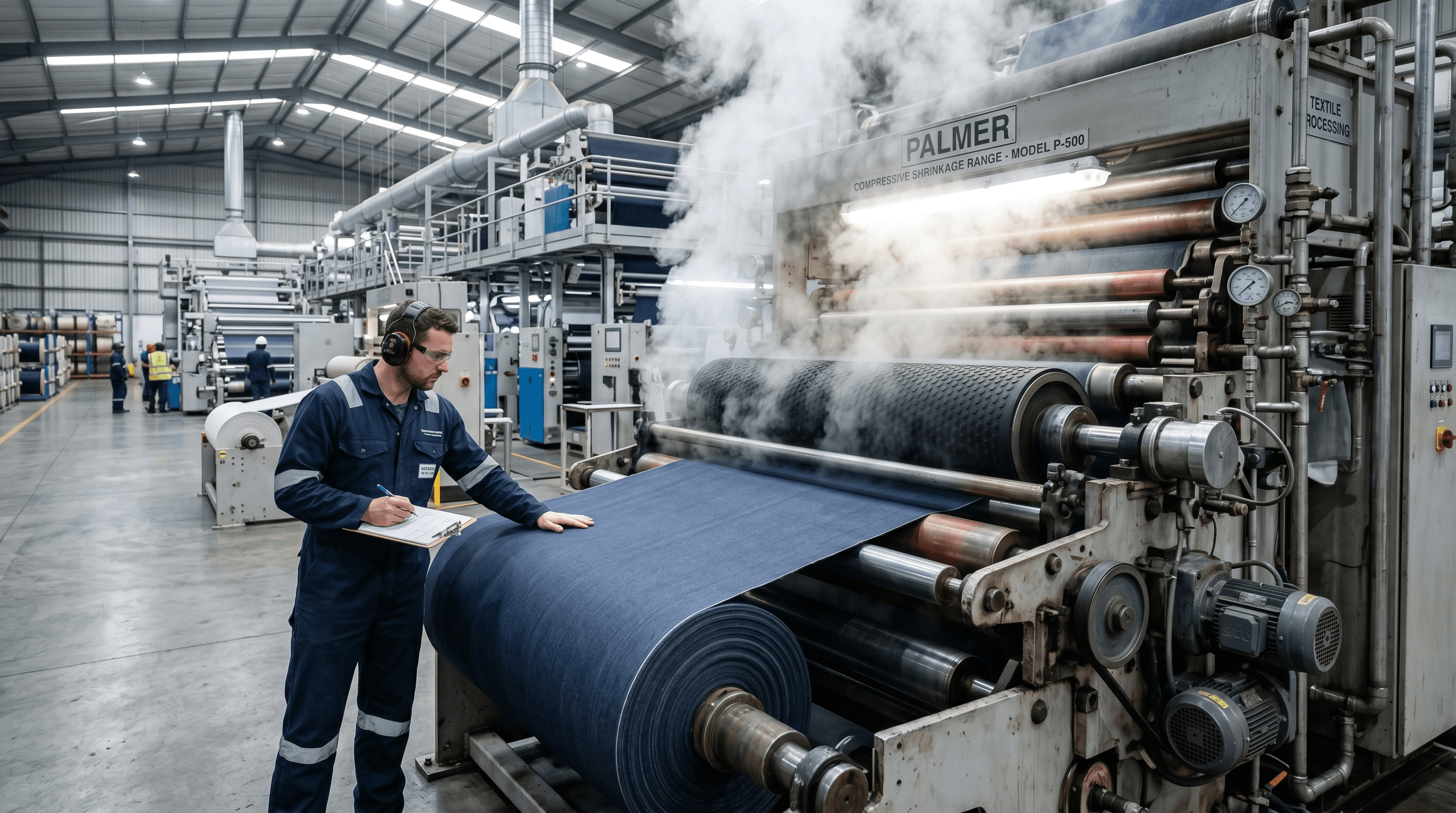
The industrial solution to catastrophic dimensional failure is a process patented by Sanford L. Cluett in 1930, known as Sanforization (or controlled compressive shrinkage). This is not a chemical treatment; it is an applied physical engineering process.
The Anatomy of the Sanforizing Machine
The objective of Sanforization is to forcefully simulate the shrinkage that would naturally occur over dozens of heavy wash cycles, executing it in a highly controlled, uniform environment before the fabric is cut.
- Moistening and Swelling: The raw fabric is fed through a spray manifold and a steaming chamber. The application of precise steam vapor causes the cellulose fibers to swell and lubricates the yarns, making them highly pliable and ready for compression.
- The Palmer Cylinder and Rubber Blanket Mechanism: This is the core engine of the process. The fabric is fed between a thick, endless rubber belt and a massive, heated steam cylinder (the Palmer cylinder).
- Compressive Forcing: As the thick rubber belt travels over a smaller feed-in roller, the outer surface of the rubber stretches. The fabric is firmly pressed against this stretched rubber. As the belt continues onto the larger, heated Palmer cylinder, the rubber surface forcefully contracts to its original length.
- Locking the Dimension: Because the fabric is tightly pinned between the contracting rubber and the hot metal drum, the warp yarns are physically forced to buckle and pack tightly together. The heat from the cylinder (often exceeding 150°C) immediately dries the fabric, setting the hydrogen bonds in this newly compressed, perfectly relaxed state.
The Engineering Result: Fabrics subjected to true Sanforization exit the line with a guaranteed residual shrinkage of less than 1% to 3%. The "clown suit effect" is eliminated entirely.
4. Case Study Comparisons: Budget vs. Engineered Solutions
To demonstrate the financial and operational impact of ignoring dimensional stability, we modeled a comparison of a 500-man workforce operating in a heavy manufacturing plant, requiring heavy-duty cotton drill coveralls.
| Metric | Budget Solution (Un-stabilized Cotton) | Engineered Solution (Sanforized Cotton) |
|---|---|---|
| Initial Unit Cost | $18.00 | $26.00 |
| Claimed Shrinkage | "Pre-Washed" (Vague) | < 2% (ISO 15797 Certified) |
| Actual Shrinkage (After 15 Washes) | 6.5% (Severe fit alteration) | 1.8% (Negligible fit alteration) |
| Lifespan to Failure | 2.5 Months (Due to seam bursts/sizing failure) | 9 Months |
| Units Required Per Worker/Year | 4.8 units | 1.3 units |
| Annual Garment Spend (500 Workers) | $43,200 | $16,900 |
| Operational Outcome | High complaints, exposed skin, frequent safety audit failures, restricted mobility. | High worker satisfaction, sustained safety compliance, reduced administrative burden. |
5. Common Procurement Mistakes in Fabric Sourcing
Buyers frequently fall into terminology traps. Below is a forensic breakdown of how supply chain officers fail to secure dimensionally stable PPE.
| The Procurement Mistake | The Mechanical Impact | The Prevention Strategy (Audit Protocol) |
|---|---|---|
| Accepting the term "Pre-Shrunk" | "Pre-shrunk" often just means a light hot-water wash. It does not mechanically compress the fibers. Fabric will continue to shrink progressively up to 8%. | Demand Sanforization. Specify "Controlled Compressive Shrinkage" in the tender document and require ISO 5077 test reports. |
| Ignoring the Difference Between Warp and Weft | Buyers look at average shrinkage. A fabric might shrink 1% in width (Weft) but 7% in length (Warp). | Specify Bi-directional Tolerances. The contract must read: "Maximum shrinkage <3% in BOTH Warp and Weft directions." |
| Failing to test under Industrial Laundry conditions | Relying on domestic washing tests (ISO 6330) when the garments will face industrial tunnel washers and heavy chemical loads. | Mandate ISO 15797. Require test data showing dimensional stability after a minimum of 50 industrial laundering and drying cycles. |
| Overlooking Seam Pucker | Even if the fabric is stable, using cheap, high-shrinkage polyester sewing thread causes massive seam puckering. | Specify Thread Stability. Mandate core-spun, low-shrinkage industrial sewing threads (e.g., premium YKK or Coats threads). |
6. ROI Analysis: The Mathematical Case for Sanforization
Procurement departments are often pressured to lower initial unit costs (CAPEX). However, analyzing workwear through a Total Cost of Ownership (TCO) lens completely invalidates the budget approach.
Let us evaluate a standard contract for 2,000 workers in a petrochemical facility.
- Scenario A (Budget): Garments cost $22. Shrinkage exceeds 5% by wash 20. Garments become non-compliant (ankles exposed) and seam stress causes blowouts. Replacement cycle is 3 times per year. Total Annual Cost: $132,000.
- Scenario B (Engineered): Garments utilizing Sanforized fabric cost $31. Shrinkage is capped at 1.5%. Garments maintain their protective envelope and structural integrity through 60+ washes. Replacement cycle drops to 1.2 times per year. Total Annual Cost: $74,400.
The ROI Reality: By increasing the initial expenditure by $9 per unit, the corporation achieves a 43.6% reduction in total annual PPE expenditure, saving $57,600, while simultaneously eliminating the legal liability of non-compliant, undersized protective wear.
7. Buyer Checklist: Auditing for Dimensional Stability
Do not sign a purchase order without verifying the following forensic data points:
- [ ] Data Sheet Verification: Does the technical data sheet (TDS) explicitly state the residual shrinkage percentage?
- [ ] Third-Party Validation: Do you possess a recent lab report from an accredited agency (SGS, Intertek, BTTG) proving ISO 5077 or ISO 15797 compliance?
- [ ] Warp vs. Weft Breakdown: Are the shrinkage tolerances separated out for both machine direction (warp) and cross direction (weft)?
- [ ] Process Confirmation: Has the factory explicitly confirmed the use of a Palmer/Sanforizing machine during the fabric finishing stage?
- [ ] Component Consistency: Have you confirmed that the zippers, tapes, and sewing threads possess equivalent shrinkage tolerances to prevent garment distortion?
8. Frequently Asked Questions (FAQ)
Q1: Does polyester shrink the same way as cotton? A: No. Polyester is a synthetic thermoplastic fiber. It does not swell in water. However, under high heat, it can suffer from thermal shrinkage if not properly "heat-set" during manufacturing. Blends (like 65/35 Poly-Cotton) require both heat-setting for the polyester and Sanforization for the cotton to achieve total stability.
Q2: Can we reverse fabric shrinkage once it happens? A: No. While a garment can be aggressively stretched out when wet, it will immediately retract upon drying. The structural realignment of the molecular hydrogen bonds is permanent.
Q3: Is "Garment Washed" the same as "Sanforized"? A: Absolutely not. "Garment washing" is an aesthetic treatment done after the garment is sewn to make it softer. It provides unpredictable, variable shrinkage control. Sanforization is precise, mechanical engineering applied to the raw fabric roll.
Q4: How does shrinkage impact Flame Resistant (FR) compliance? A: Shrinkage alters the geometric density of the fabric and the fit of the garment. If an FR coverall shrinks by 6%, the protective air gap between the garment and the skin is reduced, increasing burn transfer risk. Furthermore, exposed skin at the wrists and ankles constitutes an immediate violation of NFPA 2112 and EN ISO 11612 protocols.
9. Advanced Sourcing Strategies: Upgrading Your Supply Chain
Elite procurement teams do not just buy products; they engineer supply chains. To safeguard your PPE programs against shrinkage failures, implement the "Golden Sample Wash Test." Before approving bulk production, demand three pre-production samples. Subject these samples to a grueling local industrial wash test (minimum 15 cycles) at your facility’s contracted laundry provider. Measure the critical dimensions (Inseam, Sleeve Length, Chest Width, Collar) before the first wash and after the 15th wash. Calculate the Delta. If the variation exceeds 3%, reject the fabric lot entirely. Force the supplier to upgrade their finishing processes rather than accepting the liability of a defective product.
10. Conclusion
In the realm of heavy industry, dimensional consistency is not a matter of vanity; it is a critical safety parameter. The "clown suit effect"—where workers are forced into restricted, shrunken garments—is the visible symptom of a procurement strategy that prioritized unit cost over engineering integrity.
By demanding Sanforized textiles, safety directors eliminate the unpredictable variable of relaxation shrinkage. You preserve the protective envelope of the garment, protect the mobility of the worker, and drastically reduce your annual replacement expenditures. True workwear durability is engineered at the molecular level before the fabric is ever cut.
📩 Need help sourcing or auditing Fabric Shrinkage: The Sanforization Secret? We specialize in technical apparel engineering and quality assurance. Email: [email protected] 🌐 www.workwearsolutions.net

 Architecting Resilience: Single Sourcing vs. Dual Sourcing Strategies in Global PPE Procurement2026年4月30日Executive Summary In the complex landscape of industrial […]
 Pattern Grading for Global Bodies: The Engineering of Anthropometric Fit in Industrial Workwear2026年4月29日In the highly regulated landscape of industrial Personal […]
 The “Light Box” Inspection: Deconstructing Fabric Defect Diagnostics and the 4-Point Quality System2026年4月28日The structural integrity and visual uniformity of […]
 The Engineering of Waterproof Breathable Workwear: A Forensic Analysis of PU Coatings vs. PTFE Membranes2026年4月24日The selection of waterproof foul-weather gear in industrial […]
 The “Button Pull” Test Protocol: Engineering Fastener Security to Mitigate Industrial Machinery and Choking Hazards2026年4月22日The “Button Pull” Test Protocol: Engineering […]
 Color Consistency: The Delta-E Standard and the End of the “Clown Suit” Effect2026年2月4日In the corporate world, a uniform is a brand’s […]